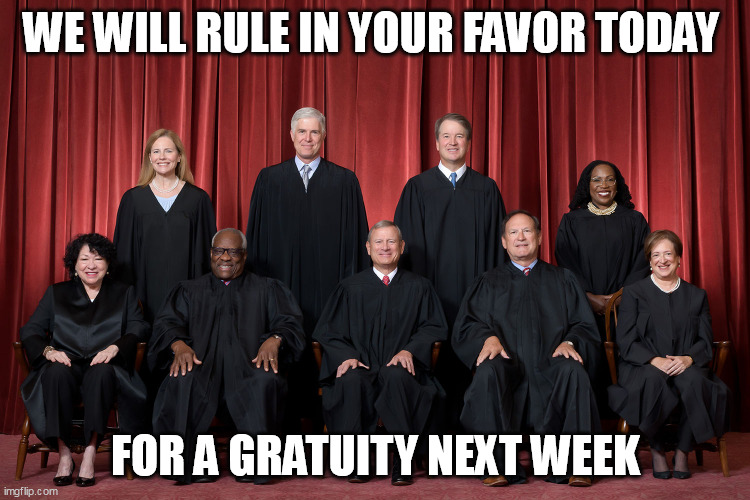
Given the out of control Supreme Court, there’s been a lot of discussions about how to reform it, but one caught my eye. It’s both maybe the most radical and the one that harkens back to one of the SCOTUS’ most venerable traditions: “circuit riding.” What’s that might you ask?
First a little context. It turns out that the text of Article III of the Constitution, which establishes the courts only does so in broad strokes—as it typically does in the other articles for establishing our government’s structure and function. The Supreme Court Historical Society summarizes:
Essentially, anything except the existence of a Supreme Court, its unique original jurisdictions, its final appellate jurisdiction, and the general principle that federal judges serve lifetime appointments, is entirely at the discretion of Congress.
And sure enough Congress has done so over the history of our country, starting with the Judiciary Act of 1789 that created the first the structure of the federal judicial system. Importantly, it can be amended like any other statute, and Congress has done so a number of times. Now back to 1789… Originally the Supreme Court justices only met two months out of the year to hear cases specific to the Supreme Court’s jurisdiction. The rest of the year they were expected to hear cases in the three-newly created regional judicial circuits, sitting on the bench with a local district judge.
The practice of riding the circuit was seen as beneficial for a number of reasons. First, the Supreme Court justices could interact with everyday Americans, learning about their lives and communities… Additionally, some members of Congress feared that if Justices were confined to the capital, they could be overly influenced by politics, which could affect their opinions and rulings. Lastly, they wanted the Justices to keep up with how the law was being interpreted at the regional level. Thus, circuit riding remained a responsibility of Supreme Court justices throughout the 19th century. [It effectively ended 122 years later in 1891.]
Hmmm, sounds like three major problems we’re facing today.
Break Up the Big Court proposes something brings back the spirit of this.
- First, double the size of the federal district/appellate courts and number of federal judges—both badly needed to handle today’s case loads. The federal court system is drastically unstaffed and overworked, meaning cases typically take years to be decided. Even if we only did this, it would be a huge win for the public, and it would bring the number of federal judges up to about 1700.
- Going forward, each case referred to the Supreme Curt would heard by nine judges randomly selected from that pool of 1,700 federal judges. In effect a jury of judges akin to how everyday trials are decided by a panel of random jurors. After deciding their specific case, they return to their regular court again.
While it has benefits similar to those of circuit riding described above, the author argues:
Its chief virtues are that it maximizes the wisdom of the crowd–which is one of the chief instrumental arguments for democracy itself–and it leverages the incorruptibility of chance, which is the observation that you cannot bribe an official who does not know they will be in position to be bribed. In short, a decision made by a random selection from the larger body of decision makers has a higher chance of better outcomes than one than one made by a fixed group of specialists, and it’s difficult for billionaires to know which judges need a lavish yacht cruise to convince them of the merits of ruling a certain way on certain cases if the judges themselves don’t know which cases they’ll be ruling on.
Obviously there’s probably some tweaking needed. E.g. Constitutional Law is its own specialty, so we’d want to ensure judges called to decide SCOTUS cases are knowledgeable about it—albeit currently new Supreme Court justices generally learn on the job. Likewise, it probably makes sense to require a minimum tenure on the federal bench—maybe five years?—to be eligible for this “federal judge jury pool.” (Albeit the trade-off is we’d initially be stuck with the current pool of judges—including all the Trump-appointed ones.) Others have suggested that logistically it might be more practical for judges to sit on the SCOTUS for one-year periods. And I’m sure there’s various loose ends to be dealt with, specifically what to do with the existing Supreme Court justices? Although one solution might be:
Article III requires “one” Supreme Court
It has zero provisions on what entity that “one” is
There is no constitutional problem with a Judiciary Act of 2029 designating a new entity to be the “one” and stripping the old one of that designation
— T. Greg Doucette (@gregdoucette.bsky.social) April 23, 2026 at 8:03 AM
While simultaneously drastically narrowing the jurisdiction of the existing court.
No, they just couldn’t be fired from their positions. They’d remain on the same court they were appointed to, it just happens that court’s jurisdiction would now be something like 3rd Amendment appeals
— T. Greg Doucette (@gregdoucette.bsky.social) April 23, 2026 at 8:09 AM
Mind you, I’m not a lawyer, merely a bear of little brain. So I’ll defer to our actual jackal lawyers. But I find the idea intriguing.
Going Back To The Future To Fix The Corrupt SCOTUSPost + Comments (63)