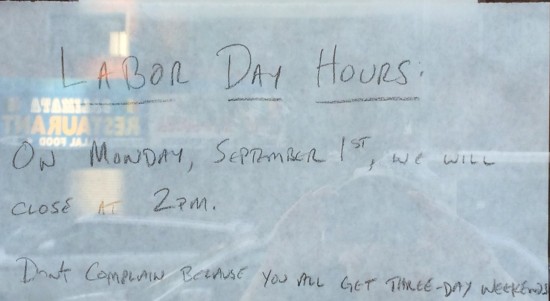
While we’re technically still in the Labor-Day window, I want to recommend Ed Kilgore’s Washington Monthly post on “Anti-Labor Day“:
I’m pretty sure I’ve mentioned here before the profound effect of spending my most formative childhood years in a place that was sort of a monument to capital’s war on labor. LaGrange, Georgia, in the early 1960s was a textile company town ruled economically, politically & socially by the Callaway family, proprietors of Callaway Mills. People there still talked—whispered, really—about the anti-union violence that occurred there a generation earlier…
To be clear, the National Guard in LaGrange and other textile towns wasn’t just breaking strikes: it was evicting workers from their (company-owned) homes for any hint of union activity. It was state-sponsored class terror, and it succeeded.
Things didn’t changed much in LaGrange in the generation after the Uprising of ‘34 was crushed. As a particularly clear sign of anti-union animus, the public schools in LaGrange began class on Labor Day each year. While I was living there, Callaway family scion “Bo” was elected to Congress in the Goldwater landslide of ‘64 as an segre- gationist Republican. Two years later his views on civil rights almost certainly cost him the governorship of Georgia as a write-in campaign denied Callaway a popular majority against arch- segregationist Lester Maddox, who was subsequently elected by the legislature on a party-line vote. Two years after that Callaway patriarch Fuller stunned LaGrange by selling out his mills to the South Carolina-based Milliken empire….
… And a much more upbeat, hopeful Boston Globe article on today’s celebrations in Lawrence, the home of “Bread & Roses”:
Looking for a sign that labor still has the ability to fight?
Consider a ceremony planned for Monday as part of the 30th annual Bread & Roses Heritage Festival on the Campagnone Common in Lawrence. Laying a wreath at the 1912 Strikers’ Monument will be a group of Market Basket workers.
“The biggest parallel that I see is the ability of a broad cross-section of workers at Market Basket to remain together over the last eight weeks,” said Robert Forrant, a University of Massachusetts Lowell history professor who will speak at the festival on comparing the Market Basket struggle — which ended Wednesday — to the nine-week strike of 1912.
“The owners never anticipated that the workers would hold fast to such a degree, and the same thing was the case in Lawrence in 1912,” Forrant said. “When the Bread and Roses Strike started, mill owners were quoted in the Lawrence newspapers the second day of the walkout [as saying that] everybody would be back to work in a couple of days and it would all be over.”
In both cases, the owners were wrong….