• Menu
  • Skip to primary navigation
  • Skip to main content
  • Skip to primary sidebar

Before Header

  • About Us
  • Lexicon
  • Contact Us
  • Our Store
  • ↑
  • ↓

Balloon Juice

Come for the politics, stay for the snark.

Stop using mental illness to avoid talking about armed white supremacy.

Their freedom requires your slavery.

This has so much WTF written all over it that it is hard to comprehend.

We cannot abandon the truth and remain a free nation.

Incompetence, fear, or corruption? why not all three?

No offense, but this thread hasn’t been about you for quite a while.

When tyranny becomes law, rebellion becomes duty. ~Thomas Jefferson

Well, whatever it is, it’s better than being a Republican.

“Jesus paying for the sins of everyone is an insult to those who paid for their own sins.”

Marge, god is saying you’re stupid.

Speaking of republicans, is there a way for a political party to declare intellectual bankruptcy?

Is it irresponsible to speculate? It is irresponsible not to.

Authoritarian republicans are opposed to freedom for the rest of us.

Giving up is unforgivable.

T R E 4 5 O N

The poor and middle-class pay taxes, the rich pay accountants, the wealthy pay politicians.

We still have time to mess this up!

The gop is a fucking disgrace.

If ‘weird’ was the finish line, they ran through the tape and kept running.

Let’s delete this post and never speak of this again.

You are so fucked. Still, I wish you the best of luck.

“Perhaps I should have considered other options.” (head-desk)

Sadly, media malpractice has become standard practice.

So very ready.

Mobile Menu

  • 2026 Targeted Political Fundraising
  • Donate with Venmo, Zelle & PayPal
  • Site Feedback
  • War in Ukraine
  • Submit Photos to On the Road
  • Politics
  • On The Road
  • Open Threads
  • Topics
  • Authors
  • About Us
  • Contact Us
  • Lexicon
  • Our Store
  • Politics
  • Open Threads
  • 2025 Activism
  • Garden Chats
  • On The Road
  • Targeted Fundraising!
You are here: Home / Archives for Tom Levenson

Tom has been a Balloon Juice writer since 2010.

Tom Levenson

Respite: Antimatter To Go Edition

by Tom Levenson|  March 25, 20264:12 pm| 114 Comments

This post is in: Open Threads, Respite, Science & Technology

I’ve got a ton of rage-inducing stuff in the pipeline which I hope to start putting up here and there soon. But I promised some respite, and I’m a content-generator of my (often deadline-missing) word, so here’s a bit of fun for your Wednesday afternoon.

Humankind has just witnessed its latest never-before achievement. Yesterday a truck hit the road within the CERN campus near Geneva. It was transporting very, VERY carefully a cargo created within that laboratory, Europe’s particle physics research center.

That cargo was antimatter. To be precise, that truck transported a grand total of 92 antiprotons, produced in a facility at CERN known informally as the antimatter factory.

Antimatter is just like the ordinary matter you and I are made of, but for one crucial difference: each of its particles has the opposite charge of its ordinary matter counterpart. An antiproton has a negative charge instead of the positive charge of the protons in the nuclei in every atom in our bodies/the universe, for example. (There are a handful of other reversed properties, but that’s the gist.)

One other thing: matter and its anti- counterpart really, REALLY don’t like each other. If an anti-proton comes into contact with a scrap of ordinary matter, it goes BOOM!—the two particles annihilate.

Respite: Antimatter To Go Edition

So antimatter is hard to make in a world full of the other stuff, and once created (which CERN does by ramming protons into metal targets and then capturing a small fraction of the anti-protons created in the flash of collision energy), is even harder to preserve.

To simplify a lot, the way to hang on to antimatter in this vale of tears is to trap it in such a way that it never comes into contact with its surroundings. Doing so requires extreme cold—four degrees K above absolute zero; as near a complete vacuum as technically achievable; and superconducting magnets to hold the antiprotons in a tight enough grasp to ensure they never strike the sides of the containment vessel.

This is not an easy task in a lab. Now imagine what it would take if an antiproton developed an urge for going.* The need to figure out how to transport antimatter arose because the CERN is an electromagnetically busy place, and some of the experiments researchers hoped to perform with antimatter couldn’t be done except in a much more pristine setting—which is being built in Dusseldorf, Germany, 700 kilometers from Geneva.

So the laboratory’s antimatter folks found themselves in the trucking business. Getting antiprotons to become rolling cargo involved designing a traveling version of the containment technology used in the lab. Today marked the first test of the system. A box truck set off on what accumulated into a half-hour, eight kilometer drive—a careful journey, topping out at forty-two kilometers per hour.

Antimatter is implicated in a range of fundamental questions, among them, why there is so much matter and so little antimatter in our universe (which is a good thing from a wholly selfish point of view; if the Big Bang had generated equal amounts of both forms of matter, as some calculations suggest it could have, then there’d be nothing in our neighborhood but the residue of the vast mutual annihilation of the two species of particles). So there’s a lot riding on the ability first to create a storable stock of antiparticles and then to get it into the right environment for ultra-precise measurement.

A five mile jaunt on a secured right of way is only the beginning. It will be a while yet before you can DoorDash an order of anti-hydrogen with some frites on the side. But it is amazing for all of that. Human beings have managed to reach into the realm previously reserved for action on a cosmological scale—and now the antimatter show has hit the road.

To put this another way: we just witnessed the Winter Olympics. We saw extraordinarily accomplished people do exceptional things. While almost every last person watching will never attempt, much less land, a quad axel or a 1620 rotation on a freestyle jump, it is thrilling to witness, to know it can be done.

Same here, learning of those 92 antiprotons made it out and back safely using machinery that is at the very limit of what humankind knows how to build.

More detail at the source for this post.

*Inevitable soundtrack. Inevitable alternate soundtrack.

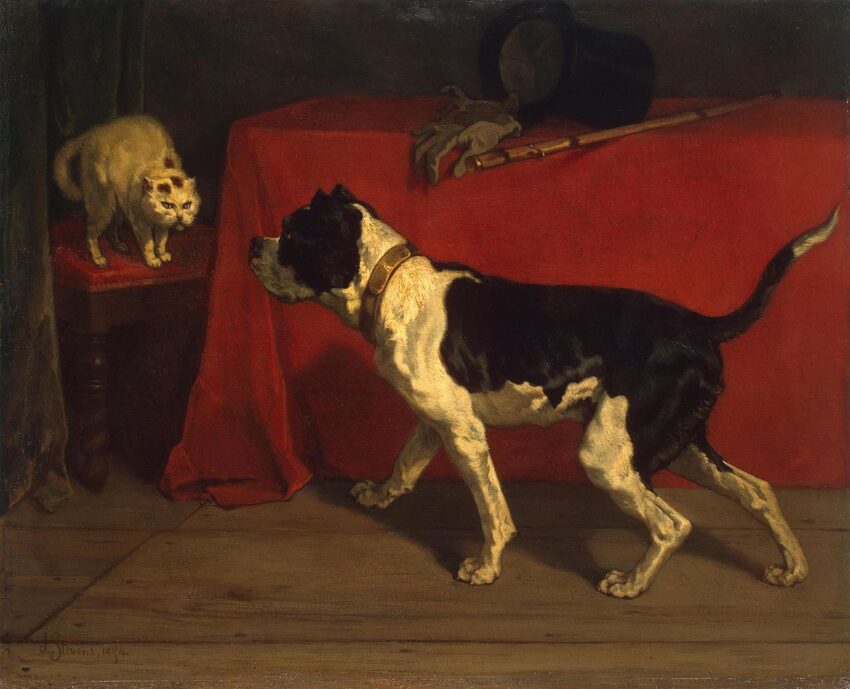
Image: Joseph Stevens, Enemies, 1854

Respite: Antimatter To Go EditionPost + Comments (114)

Respite: At Play in the Fields of the LLMs

by Tom Levenson|  March 1, 20266:17 pm| 109 Comments

This post is in: Open Threads, Respite, Technology, General Stupidity

ETA: This was written for Balloon Juice but is crossposted at Inverse Square.

So…

Just this week I learned that through my home institution I have access to a suite of LLMs, including all the usual suspects (Anthropic’s Claude, OpenAI’s ChapGPT, Meta’s Llama, and Google’s Gemini. MIT’s come up with a very nice interface to interact with all this artificial talent, and I’ve spent a couple of hours this weekend taking some of them out for a spin. (I’m avoiding OpenAI’s offerings both as a trivial protest and because I don’t trust anything about that company.

So far I’ve enjoyed Claude the most (the Haiku 4.5 model, if you’re wondering). Gemini is interesting, if a bit finicky. But what made me howl was the encounter I just had with Llama, Mr. Zuckerberg’s contribution to the genre. Context: over the holidays I  had a conversation with a senior person at another magnificent 7 tech firm who’d just seen a colleague leave to go to Meta who was utterly dismissive of the company and relieved to be rid of anyone dumb enough (in his view) to basically end his career in top-tier tech by grabbing Facebook bucks. Spoiler: after what you’ll read below, I can see where my friend was coming from.

So here’s the setup. I’ve been asking the various models what I hope are zero-consequence questions, queries in which no one could possibly get hurt if the LLMs wing their way to utter bollocks. A typical ask: map out the logical structure Einstein used in his 1905 light quantum behavior. That one tended to get an initial poor answer based on the idea that the paper centers on the then-pressing mystery of the photoelectric effect–a common mistake for people as well as machines. Pressing the models led Claude in particular to a much more sophisticated account of the paper drawing attention to the way Einstein used arguments from thermodynamics to propose the necessity of understanding light as discrete packets of energy.

Respite: At Play in t

The paper was about this new “heuristic” [Einstein’s term] view of light, and the photoelectric effect appears only as one experimental support for that view. (Much more here.)

After three or four trips through the query engineering needed to get a useful result I’d found my way down the list of models at my disposal to Meta’s Llama.  I was bored with light quanta and so asked a different, much simpler question:

“When a stock is overvalued as defined by a price to earnings ratio a standard deviation or more higher than historical market norms for that company’s sector, what are the typical events or analyses that drive that share price back down to the norm?”

Llama gave me a very stock answer that would have been at home in a high school economics class, so I decided to become a little more pointed in my pursuit:

Given that analysis, how would you explain Tesla’s long run of share prices between one and two orders of magnitude over that of other and much larger and more profitable car companies, like Toyota?

What followed was…first unimpressive and then hilarious. See for yourselves below the jump:

show full post on front page

Respite: At Play in the Fields of the LLMsPost + Comments (109)

Tesla’s Valuation Puzzle

Tesla’s share price has been a subject of fascination and debate, with its valuation often being significantly higher than that of other automakers, including Toyota. To understand this phenomenon, let’s examine the factors that have contributed to Tesla’s premium valuation.

Growth and Disruption

  1. Pioneering electric vehicles (EVs): Tesla was one of the first companies to successfully mass-produce EVs, creating a new market and disrupting the traditional automotive industry.
  2. Innovative technology: Tesla has been at the forefront of EV technology, with advancements in battery management, autonomous driving, and software updates.
  3. Brand loyalty and cult following: Tesla has built a strong brand identity, with a loyal customer base and a reputation for innovation and sustainability.

Investor Sentiment and Expectations

  1. Growth expectations: Investors have high expectations for Tesla’s future growth, driven by its expanding product lineup, increasing production capacity, and potential for further market disruption.
  2. Long-term vision: Tesla’s mission to accelerate the world’s transition to sustainable energy has resonated with investors, who are willing to look beyond short-term profitability.
  3. Charismatic leadership: Elon Musk’s leadership and vision have been instrumental in shaping Tesla’s brand and driving investor enthusiasm.

Valuation Metrics and Comparisons

  1. Price-to-earnings (P/E) ratio: Tesla’s P/E ratio has often been significantly higher than that of traditional automakers, reflecting its growth prospects and investor expectations.
  2. Price-to-sales (P/S) ratio: Tesla’s P/S ratio has also been elevated, indicating that investors are willing to pay a premium for its revenue growth.
  3. Comparison to other growth stocks: Tesla’s valuation has been compared to that of other growth stocks, such as Amazon or Shopify, which have also experienced significant premium valuations.

Challenges and Risks

  1. Competition from established automakers: Traditional automakers, including Toyota, have been investing heavily in EV technology, potentially eroding Tesla’s competitive advantage.
  2. Production and delivery challenges: Tesla has faced production and delivery issues in the past, which can impact its ability to meet growth expectations.
  3. Regulatory risks: Changes in government policies or regulations can affect Tesla’s business, particularly if they impact the demand for EVs or the company’s access to incentives.

Why Tesla’s Valuation Has Remained High

Despite the challenges and risks, Tesla’s valuation has remained high due to a combination of factors:

  1. Continued growth and innovation: Tesla has continued to innovate and expand its product lineup, maintaining its position as a leader in the EV market.
  2. Investor enthusiasm and momentum: The company’s strong brand and charismatic leadership have maintained investor enthusiasm, driving the stock price higher.
  3. Speculative buying and short squeezes: Tesla’s stock has been subject to speculative buying and short squeezes, which can contribute to its high valuation.

Comparison to Toyota

Toyota, on the other hand, is a more established automaker with a larger market capitalization and a more diversified product lineup. While Toyota has been investing in EV technology, its valuation has been more in line with traditional automakers. The key differences between Tesla and Toyota are:

  1. Growth prospects: Tesla is expected to continue growing at a faster rate than Toyota, driven by its focus on EVs and innovative technology.
  2. Brand identity and disruption: Tesla has created a new market and disrupted the traditional automotive industry, whereas Toyota is a more established player with a different business model.

In conclusion, Tesla’s high valuation relative to Toyota and other traditional automakers can be attributed to a combination of factors, including its growth prospects, innovative technology, brand loyalty, and investor enthusiasm. While there are challenges and risks associated with Tesla’s business, its continued innovation and growth have maintained its premium valuation.

I saw a few problems with that conclusion, so I asked again:

I’d like you to follow up on that analysis. You say Tesla has an expanding product lineup; it has just discontinued its two largest models (Model S and Model X). The cybertruck has failed to become a mass market vehicle. And global sales are declining while Tesla has been overtaken by BYD as the world’s largest EV maker. Its innovation process has slowed, and it is arguably behind Waymo and others in autonomous driving. Its leader is a controversial figure, whose presence energizes one community but since 2024 at least has alienated another, arguably of those more likely to buy an EV. Are you sure that these are the factors that explain Tesla’s share price? Or to put it another way, would you invest Meta’s money in Tesla at the current P/E ratio?

What followed is, it seems to me, a perfect anecdata demonstration of why we might not want to surrender all of our critical faculties to a set of silicon overlords. Map what Llama says onto what I asked:

Revisiting Tesla’s Valuation

Upon further analysis, it appears that the factors I previously mentioned may not be as relevant as they once were. Tesla’s product lineup has indeed been contracting, with the discontinuation of its two largest models, the Model S and Model X. The Cybertruck, while innovative, has not achieved mass market success. Additionally, Tesla’s global sales have been declining, and the company has been overtaken by BYD as the world’s largest EV maker.

Challenges and Concerns

  1. Declining sales and market share: Tesla’s sales have been declining, and the company has lost its position as the world’s largest EV maker.
  2. Innovation slowdown: Tesla’s innovation process has slowed, particularly in the area of autonomous driving, where it is being surpassed by competitors like Waymo.
  3. Controversy surrounding Elon Musk: Elon Musk’s leadership and behavior have become increasingly polarizing, potentially alienating a significant portion of potential customers.

Reevaluating Tesla’s Valuation

In light of these challenges and concerns, it’s reasonable to question whether Tesla’s current valuation is justified. The company’s P/E ratio is still relatively high, indicating that investors are willing to pay a premium for its shares.

Investment Decision

If I were to advise Meta on investing in Tesla at the current P/E ratio, I would likely recommend caution. While Tesla is still a pioneering company in the EV space, its current challenges and concerns suggest that its growth prospects may be more limited than previously thought.

Alternative Investment Opportunities

There may be other investment opportunities in the EV or technology spaces that offer more attractive growth prospects and valuations. For example, companies like BYD, NIO, or Li Auto may offer more compelling investment opportunities due to their growth potential and competitive positioning.

Conclusion

In conclusion, while Tesla is still a significant player in the EV market, its current challenges and concerns suggest that its valuation may be due for a correction. As an investor, it’s essential to carefully evaluate the company’s prospects and consider alternative investment opportunities before making a decision. At the current P/E ratio, I would likely advise against investing in Tesla, and instead, explore other opportunities that offer more attractive growth prospects and valuations.

That’s a 180 degree swing from the prior answer, generated by nothing more than calling bullshit on the model’s first conclusion.

What does it all mean?

Hell if I know. I’m as far from an expert on all of this stuff as it’s possible to be. I’m just a guy with access to a very funny set of hammers out here looking for nails.

One thought though: there’s a lot of evidence out there, some of which I’ve encountered directly from colleagues and friends, in which various AI approaches have real and large impacts on various problems. Folks doing drug discovery or protein analysis or a lot of coding tasks and…well the list goes on. And in just my brief playtime with Claude et al., I got some distinct value from the LLMs’ ability to look at specific texts and break them down. So anyone saying AI is a fraud top to bottom is, I think, clearly wrong.

But those who think that a general machine intelligence is right around the corner…well, the Llama case above seems to me a pretty clear example of how a statistical inference machine operating on a bucket full of internet slop may not be all that, not yet and quite possibly not for an arbitrarily long time to come.

Image: J. M. W. Turner, Keelman hauling coals by moonlight, 1835

Respite: Some Vaccine Good News

by Tom Levenson|  February 20, 202611:08 pm| 20 Comments

This post is in: Healthcare, Open Threads, Respite, Science & Technology

Meant to get this up earlier, but life got in the way,  so I’m just going to post this anyway, just to give us some good news to chew on.

First up on what I guess we can call vaccine Friday: we can now immunize you against a whole bunch of nasty viruses all at once–if you’re a mouse.

Quick Respite/Reminder: Vaccines Are...Kinda Good, Ya Know

This is from the Nature summary of the research, which was published today in Science.

Imagine if a nasal spray could make you immune not only to the viruses that cause COVID-19 and influenza, but to all respiratory diseases. In a paper1published in Science today, researchers describe a vaccine that has done just that. When given to mice, the vaccine protected them for at least three months against multiple disease-causing viruses and bacteria — including the SARS-CoV-2 virus that causes COVID-19 — and even quelling responses to respiratory allergens.

What’s coolest about this (to my historically inclined mind) is that the research that led to this new “universal” vaccine began with an investigation of an old one, the Bacillus Calmette–Guérin (BCG) vaccine. BCG was developed over more than half a century in Germany and France in an effort that began with the isolation of the bacterium that’s the pathogen behind bovine tuberculosis, and culminated with work at the Pasteur Institute that followed Louis Pasteur’s signature move of attenuating a disease-causing microbe until it could induce immunity without making the person receiving the jab sick. It became the first vaccine for tuberculosis in 1921.

Fast forward a century, and the mechanism of action in that vaccine–activating the latent immune system, which, as Liam Drew writes in that Nature summary, is an  “evolutionarily ancient system [that] has a much broader reactivity than does the adaptive immune system”–led researchers to this:

In the latest study, Pulendran’s team developed a universal vaccine that targets the innate immune system, with three components. The first two are drugs that stimulate specific receptor proteins that can activate innate immune cells, such as macrophages that reside in the lungs. [link in the original]

The third component stimulates a population of T cells, which are part of the adaptive immune system. Their task is to keep sending signals to the innate immune system to maintain its active state.”

The vaccine works a treat in mice, but, as the linked Nature news piece makes clear, there are significant hurdles to overcome to create a safe and effective human version. But even so, this is a necessary and genuinely exciting first step.

The second bit of good vaccine news–not so much “good” as “promising” or potentially valuable–comes from a very early human trial of personalized mRNA vaccines for triple-negative breast cancer, a particularly nasty and intractable form of disease in which the cancer cells lack targets for the three most common drugs for the condition.

A paper published in Nature a couple of days ago provided the results of a trial of a vaccine approach that in essence persuades patients’ immune systems to react to the drugs, using mRNA as the vector–or as the clinical brief summary put it:

We conducted an exploratory trial of these personalized vaccines to assess their feasibility, safety and mechanism of action, rather than clinical benefit. We genetically sequenced tumour cells and healthy cells from 14 individuals with early-stage, surgically removed TNBC and used algorithms to select mutations that generate neoantigens. For each participant, we manufactured a personalized mRNA vaccine encoding up to 20 neoantigens. Once administered intravenously, the vaccine reaches lymphoid organs, where T cells are taught how to recognize the mRNA-encoded neoantigens.

This trial was intended to test the feasibility of the approach, but it did have an impact on the patients involved:

Ten participants remained disease-free, and one participant died of unknown causes. Relapse occurred in three individuals, enabling us to gain insights into possible resistance mechanisms.

Again–very early work, miles to go before we sleep, and caution around any small scale cancer study is not just warranted but required. Still, another exciting first step.

In sum: A) science is so cool. And B) while this is a respite post, I’d be remiss if I didn’t add that this is reason ∞ that RFK Jr.’s antivaccine crusade–and his anti-mRNA technology pathology in particular–is such a disaster. Both of the studies above are fine preliminary research results. They won’t mean anything if the next stages of the work don’t happen, and if the US scientific shut down continues for much longer, the basic science that won’t get done will prevent any new such leads to appear. Worse, the damage so far to ongoing research program is such that we’ve already lost potential advances in human flourishing.

So yes, this is all good news. But there’s a lot of work to be done to make it possible for more such promising outcomes to arrive down the road.

Happy weekend, everyone. The thread, as usual, is open.

[Crossposted at Inverse Square]

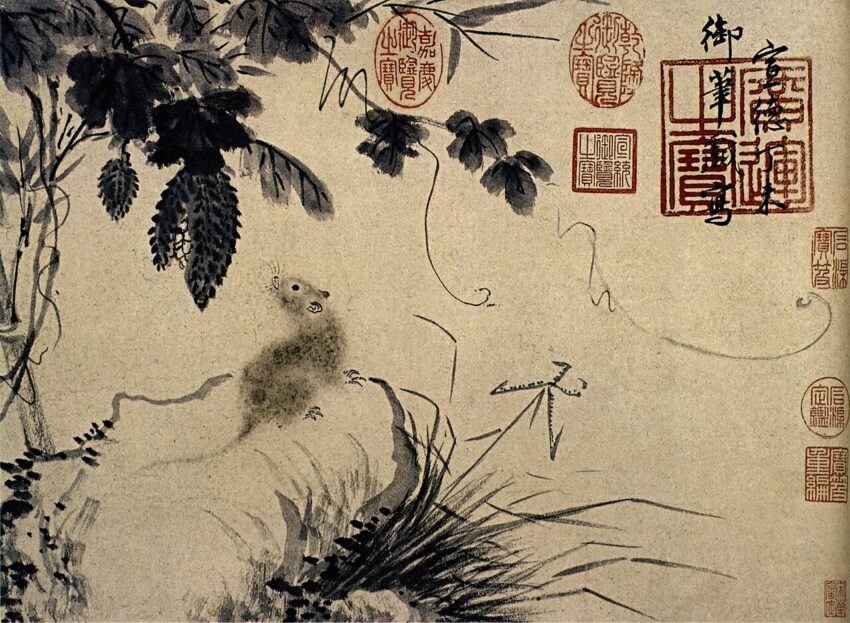
Image Zhu Zhenji, Mouse and stone, 1427.

Respite: Some Vaccine Good NewsPost + Comments (20)

The Vaccine Crisis…It’s here.

by Tom Levenson|  February 16, 20268:04 pm| 14 Comments

This post is in: Healthcare, Open Threads, Republican Stupidity

NB: Another cross post with Inverse Square. As ever, if you would like to get email notifications of these regrettably uncheery updates (and some happier ones, I hope) you can subscribe over there.

——————————-

Sometimes, working on a book means that you see references to your work everywhere you look, when what’s really going on is that you (me, to be honest) only retains stuff that connects with your (my) obsession of the moment.

Other times, though, it really is all about whatever it is I’m most deeply engaged with at the moment.

As now.

The vaccine crisis is real, much more imminently threatening than I dreamed a year ago, when I started working on a polemical history of objections to vaccination.

Rebecca Robins captures the current state of play in her story today in the New York Times. The headline and its subhed pretty much say it all: “Vaccine Makers Curtail Research and Cut Jobs” followed by “Federal policies under Robert F. Kennedy Jr. that are hostile to vaccines have “sent a chill through the entire industry,” one scientist said.”

The rest of the piece lays out in detail what’s going wrong. There’s a flat rejection of the most promising new vaccine approach, the use of mRNA technology, which that noted virologist and molecular biologist Robert Kennedy tells is not effective. (He’s neither, of course, and he’s flat wrong.) There’s a sustained discouragement of vaccination coming down from the top ranks of US public health, starting with lopping off one third of the list of (formerly) recommended childhood vaccines. (Measles, pertussis, and now mumps all thank Secretary Kennedy.) And Robins writes of perhaps the most potent weapon anti-vax campaigners at HHS have to shadow ban most or all vaccines: revising the current vaccine injury compensation system to expose vaccine makers to unlimited liability for alleged harms. That would mark a return to the way it was in the 1970s and 80s, when almost all vaccine manufacturers were driven from the US market. No need to prohibit immunization if it’s impossible to buy a shot.

Even before that, trials of potentially major new vaccines are on hold, at best. Say goodbye for the time being to possible preventatives for strep infections, for shigella, for the flu (one of the mRNA vaccines sacrificed on the altar of Kennedy’s utterly convinced ignorance), for Epstein Barr syndrome, with, I’m sure, more retreats to follow.

The Vaccine Crisis...It's here.

As Robins writes, each of those at least temporarily abandoned shots fell to business decisions, which presumably could be reversed if/when political winds shift. Another story, this one from the Boston Globe points to a less reversible loss: A brain drain (the paper’s term) of biomedical investigators that already is eroding the US research enterprise across the spectrum of medical research, very much including vaccine science.

The key takeaway from this piece, which is based on a survey of Massachusetts scientists, is that once you halt work in a lab–no matter how close that lab might be to a breakthrough–not only is that immediate result gone, the capacity to return to that research collapses too. Teams scatter, informal knowledge evaporates, and any prior results, the accumulation of insights that lead to something important, don’t travel intact as the various groups scatter.

Which is to say that the damage Trump, Kennedy, et al. doesn’t end when they lose power. It will take years—decades, quite possibly—to rebuild the scientific infrasture that we had just a little over twelve months ago. Other nations will pick up some of our people and with them the intellectual possibilities our research surrender has created.

But potential advances will be slowed, perhaps some actually lost for the foreseeable future. And for vaccines themselves, all those infections, the illnesses and deaths that could have been prevented by existing vaccines or the new ones that are now indefinitely delayed—that burden of misery will accumulate day by day until we finally get back to the status quo ante.

None of this needed to happen, but here we are. One job we need to do (and this post is part of that effort) is to make sure that Kennedy and his allies own every harm, every loss they’re inflicting on the American people. Another is to do whatever we can at the state level and with private money to save as much of American science as we can.

I wish I had something happier to write about. When I get good news, I promise to shout it from the rooftops. In the meantime I’ll just say that Paul Krugman speaks for me at the end of his post today on the madness of Trump’s energy “policy:”

For the most part, all MAGA will do is help make the United States backward, poorer, sicker and irrelevant.

Yes, yes, and yes.

This thread is as open as RFK Jr.’s mind is closed.

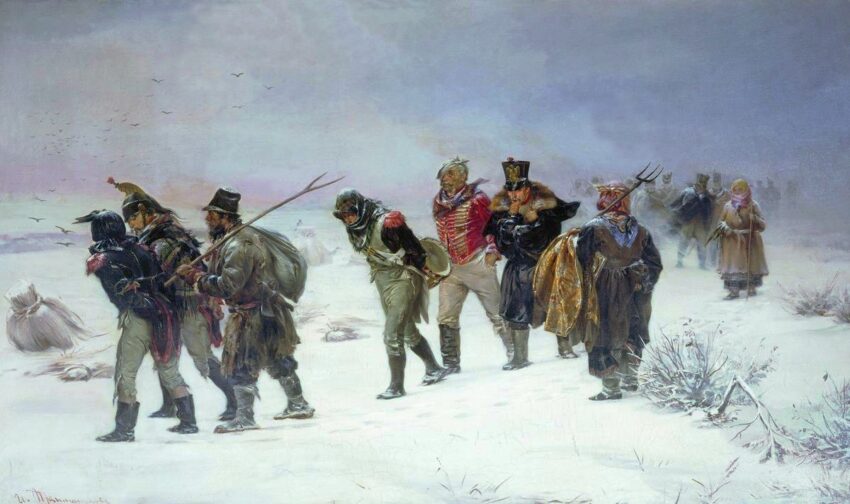
Image: Illarion Mikhailovich Pryanishnikov, French Retreat in 1812, 1874.

The Vaccine Crisis…It’s here.Post + Comments (14)

A Tale of Two Articles

by Tom Levenson|  February 13, 20268:00 pm| 20 Comments

This post is in: Healthcare, Open Threads, Republican Stupidity

First up:  a report in Nature Medicine on cancers caused by “modifiable risk factors”–as in cancers that could have been prevented by some change in behavior, environmental change, or some intervention. The global numbers are impressive: more than one third, 7.1 million of 18.7 million total cases of cancer, could possibly be prevented.

This is a kind of good news. High tech, cutting edge medicine is one front in the campaign against cancer. But a cancer that can be stopped before it begins is a hell of a lot easier to treat…and it turns out that there are a lot of them.

But flipping around such (genuinely plausible) optimism…That so many cancers world wide could be prevented leads directly to the question: why haven’t we?

Well, sometimes knowing about a risk isn’t enough to stop one from chancing it.  Unsurprisingly, it was smoking that “emerged as the dominant risk factor,” with alcohol use adding its own tithe of misery. Most people know by now that smoking can kill you, but the hold that drug exerts on its addicts makes beating that death toll down a slow, hard process.

A Tale of Two Articles

But what struck me most in the Nature report was the most pervasive avoidable risk for women: cervical cancer, over 66o,000 cases worldwide in 2022, 91% of them caused by infection by Human Papilloma Viruses (HPV).

As a world phenomenon, that burden of loss falls more on “low resource settings, particularly sub-Saharan Africa.”

Why “low resource”?

Because HPV infections that lead to cervical cancer are preventable, not perfectly so, but with high effectiveness…by a vaccine. In those parts of the world that lack robust public health and medical infrastructure, HPV vaccine coverage suffers.

So…no problem for those of us fortunate enough to live in places that do possess such institutional support, right?

I bet you can guess what comes next.

Here’s what the second article I read today tells us. This is what CIDRAP, a University of Minnesota center focusing on infectious diseases and policy responses to them, has to say:

The vaccine against human papillomavirus, or HPV, has reduced cervical cancer by nearly 90% in women vaccinated as adolescents. It has been studied in more than 50 randomized controlled trials. Over 135 million doses have been administered in the United States.

And last month, a newly formed working group under the reconstituted Advisory Committee on Immunization Practices (ACIP), which helps guide vaccine decisions by the Centers for Disease Control and Prevention (CDC) announced plans to conduct a multi-year “comprehensive review” of the vaccine’s efficacy, effectiveness, and safety.

The working group’s charter, finalized in December 2025, does not limit itself to the one genuinely open question in HPV vaccine science, whether a single dose provides adequate long-term protection. It calls for a sweeping reexamination that includes adjuvant toxicity, potential contaminants, possible HPV type replacement, and a full reassessment of safety data. It lists neurology and toxicology among the disciplines to be represented on the working group.

…Periodic review of vaccine recommendations is normal and necessary. What this charter describes is something else entirely. It is the construction of uncertainty around a vaccine whose benefits have been demonstrated more conclusively than almost any medical intervention in modern history. [Links in the original]

I don’t think I need belabor the obvious. What Robert F. Kennedy and his henchmen are doing here is an old trick. There’s no actual uncertainty about the HPV vaccine, beyond the question of dosing schedules. It works; it’s safe; and it saves lives–globally, it could prevent around 600,000 new diagnoses of cervical cancer each year.

A Tale of Two Articles 1

In the face of those established facts, what should you do if you are ideologically opposed to vaccination, or simply make your living or gain your clout by demonizing vaccines? Exactly what Kennedy is doing here. He’s sealioning; “just asking questions;” throwing enough shit at the wall to create the appearance of a controversy where none exists.

Normies, busy people with actual daily lives to lead don’t generally have the time or tools to dig through the literature to see what’s going on. They hear that the Department of Health and Human Services is concerned enough about risks to launch a comprehensive study…and, perfectly reasonably, they may hesitate when a doctor offers their kid the shot.

And with that, fewer children here will gain protection against a preventable disease. Those who encounter the virus can pass it on; chains of infection will follow, and women (mostly-there are cancers men get associated with HPV) will die before their time, wholly unnecesarily.

Right now, Rubio (and Musk) have the highest body count of Trump 2. But don’t count Kennedy out.

Dyspeptically open thread.

Images: Adriaen van Ostade, A Man Smoking, c. 1670

Louis Boilly, La vaccine, 1807

A Tale of Two ArticlesPost + Comments (20)

Respite: Writing That Makes You Go “Damn….”

by Tom Levenson|  February 12, 20267:23 pm| 43 Comments

This post is in: Books, Open Threads, Respite

NB: This is a crosspost from Inverse Square–yesterday evening, in fact. (The world kinda collapsed in around me and I didn’t have the time to close the loop then.)

This has been a bad news day, at least for my particular obsessions. I’ll post in a bit about Trump’s King Cnut moment–today’s declaration that climate change ain’t a problem, and hence all US regulation that presumes it is will die. The decision to reverse the EPA’s endangerment finding about greenhouse gasses will be tested in court and may fail there (though the Corrupt Six on the SC are not, to put it mildly, jurists that inspire confidence in the rule of law). But the potential for truly awful consequences is there and I ain’t happy.

But…one of the things about being human is that other humans have lit candles against the night, and we can take joy in that light even though the darkness is there. So as I was thinking about this week’s respite essay it struck me that I imagined myself into being a writer long before I ever seriously applied ass to chair and took on the actual work required. And that imagining sustained me as I encountered the various ways the search for words becomes a tangled labyrinth in  which one struggles to find a path through.

What launched that imagining? Reading, of course, which is hardly a revelation–but in particular sudden moments in reading when the raw power of language suddenly manifested itself. So I offer this up in the hopes that y’all might use a break from present horrors and dwell in a moment when some aesthetic experience knocked the legs from under you.

Enough preamble…here’s the post:

————————————————-

I knew I had to be a writer long before I actually did the work…laying words down on the page and moving them about until I truly knew what I thought, felt, meant.

How did I know this?

Because of the way my body responded when I came across a passage that regardless of its content—the plot—would ring out, vibrating in my gut as much as my head.

I can remember a few of those moments now, half a century and more on. There was the time I was deep in the dumps at the end of my second year of college and for some reason picked up Middlemarch. School was over; this wasn’t for a course; I wasn’t a literature student. Just happened across a copy and for no reason I can remember decided that the thing I needed to do while feeling completely at right angles to myself was read a gazillion page nineteenth century novel.

Respite: Writing That Makes You Go "Damn...."

The passage that knocked me off my feet came when Eliot broke the fourth wall to demand the reader’s sympathy for Causabon as a person whose self-preserving myths were crumbling just as he needs them most. That short moment was brilliantly written and smart, emotionally and intellectually. My depression lifted—really, just about in the moment of my reading that page and a half. Why? Because I suddenly recognized that it was possible to use words as lenses through which to see the world in previously unsuspected ways.

Then there was that brief exchange in the middle of Rudyard Kipling’s Captain’s Courageous that, again, was only minimally involved in the plot, but still stopped me dead the first time I read that book as an adult. Here it is:

Boylike, Harvey imitated all the men by turns, till he had combined Disko’s peculiar stoop at the wheel, Long Jack’s swinging overhand when the lines were hauled, Manuel’s round-shouldered but effective stroke in a dory, and Tom Platt’s generous Ohio stride along the deck.

“’Tis beautiful to see how he takes to ut,” said Long Jack, when Harvey was looking out by the windlass one thick noon. “I’ll lay my wage an’ share ‘tis more’n half play-actin’ to him, an’ he consates himself he’s a bowld mariner. Watch his little bit av a back now!”

“That’s the way we all begin,” said Tom Platt. “The boys they make believe all the time till they’ve cheated ‘emselves into bein’ men, an’ so till they die—pretendin’ an’ pretendin’. I done it on the old Ohio, I know. Stood my first watch—harbor-watch—feelin’ finer’n Farragut. Dan’s full o’ the same kind o’ notions. See ‘em now, actin’ to be genewine moss-backs—very hair a rope-yarn an’ blood Stockholm tar.”

There we all are: cheating ourselves into our grown selves—and so until we die, pretending…

Image upon image and a moment of insight that makes this book something very much more than just a Boy’s Own tale. Early on I didn’t take any lessons from it; all it did was make make me want to put pen to paper (keys to screen?). It was just so good it made my fingers itch with desire make anything even remotely as explosive.

One more. This is what I read when I was trying to write for my college newspaper a remembrance of my father on the tenth anniversary of his death. I was stuck. What to say about someone I’d last known when I was ten?

Then I read this:

Indirectly, though, he [my brother] was present in many of our conversations. Once, for instance, my father asked me a series of questions that suddenly made me wonder whether I understood even my father whom I felt closer to than any man I have ever known. “You like to tell true stories, don’t you?” he asked, and I answered, “Yes, I like to tell stories that are true.”

Then he asked, “After you have finished your true stories sometime, why don’t you make up a story and the people to go with it.”

“Only then will you understand what happened and why.

“It is those we live with and love and should know who elude us.”

Respite: Writing That Makes You Go "Damn...." 1

That’s almost the end of Norman Maclean’s novella, “A River Runs Through It.” I read the whole story in one sitting. I literally could not put it down. It’s a beautiful piece of course, tightly written, plenty of incident, more than a little humor to leaven the foreshadowed tragedy. And what it says in lines quoted above was clearly relevant to the task I had found impossible before I played hooky with a little fiction, and an almost unbelievable straight shot afterwards.

But looking back, what that brief excerpt did to or in me was to see in the act of writing the most extraordinary power I could ever desire: the ability to make worlds, explore them, and in doing so, understand what happens and why.

So that’s it from me. How about you?

What encounters with art—any art, words, sound, image, movement, all of the above—have taken you out of yourself? Where do you go when you need a moment of joy, or a sense that we do have the power we need so desparately at the current moment in this vale of tears?

And yeah, this thread is open, as usual.

Images: John Singer Sargent, Man Reading, undated.

Edma Morisot (yup…Berthe’s sister), Fisherman by a river, undated.

Respite: Writing That Makes You Go “Damn….”Post + Comments (43)

Those F**kers

by Tom Levenson|  February 10, 20268:30 pm| 49 Comments

This post is in: Healthcare, Open Threads, Republican Stupidity, Assholes, General Stupidity

NB: In the continuation of a theme, this is a repost of a cri de coeur I posted over at Linked In. By way of background: you may have heard that I’ve got a book coming out, an angry, hopefully useful polemic history of opposition to vaccines. I’m being advised/coached/commanded to live in the real world of book promotion as of 2026. That means, I’m told, working across the social media landscape. With Twitter a crater that means (for me), Bluesky (@tomlevenson.bsky.social), LinkedIn, and Substack.* (To my intense horror, I’m also being asked to make vertical videos that draw folks into the story-world of the book. I am definitely a behind-the-camera kind of guy.) So there’s going to be a steady diet of these posts that I want to put up here so as to eliminate any possible barriers to entry. If that gets onerous? Well, unless John objects, I’m gonna say that this what the scroll function is for. ;-)

———————————–

I was hoping to write about something not infuriating today–maybe that pulsar that has been tentatively detected near the center of our galaxy, or, more on my usual focus these days, on the accumulating studies that show certain vaccines may help reduce the risk of dementia in older folks.

But RFK Jr. and his crew can’t stop—won’t stop—making America sicker…

Those F**kers

…and today’s news is both bad in itself and deeply threatening for what it suggests we may face soon.

The news: the FDA will not review Moderna’s application for approval of its new mRNA based flu vaccine.* This isn’t a case of a submitted application that has been rejected for some discernible reason. It’s a flat out LALALALALA I-can’t—won’t—hear-you rejection of the application itself.

John touched on this below, but there’s a deeper layer to this egregious abuse of procedure that I want to highlight.

The justification for this refusal is that Moderna didn’t do an “adequate and well-controlled trial” of the new shot.

That is a lie. Moderna did the study agreed with the FDA in 2024, and while it did not accept an agency suggestion—not a requirement—for one modification of the trial, it provided the results of an independently conducted study that covered what the FDA was concerned about.

Which is to say that the stated reason for this blanket refusal to see if this shot could save some of the multitudes of Americans who die of the flu each year (45,000 estimated in the 2024-25 season, with a recent high of 52,000 in 2017-18) is a fig leaf to cover the actual policy decision here.

That would be to shadow ban vaccine research as a prelude to barring US access to as many vaccines as possible. To refuse to evaluate a vaccine application is to shut down years and millions of dollars of research. No one in the for profit drug business is going to put their resources into such work. Why should they?

And this move, if left to stand, will have a similar chilling effect on not-for-profit research. Grants won’t flow and researchers would have less and less incentive to stake their careers on work that might go nowhere. Not because of any scientific shortfall, but because anti-vaccine cultists have decided they’d rather hold power than save lives.

And yes…I had hoped that despite my editor saying in December 2024 that RFK Jr.’s rise to power meant that I had to write my vaccine polemic, I still (Oh! The innocence!) so desperately hoped that the depth of experience and expertise in the FDA and CDC and similar would insulate the country from the worst that could happen.

He was right and I was wrong, and I am deeply worried for us all that this is so.

What to do? I’m not sure, but calling your senators and representative and screaming in rage can’t hurt.

Open thread.

*I’m aware of sharp divisions of opinion on Substack. Some, including at least one front pager, see it as part of the neo-Nazi support structure. Others (including me) see it as part of a mediascape we can’t abandon to the assholes. I’ve been following Brad DeLong on this, and he’s both aware of the very much non-zero possibility that it won’t be possible to sustain that view and has, so far, concluded it’s worth sticking around. He’s my canary in the coal mine.

My somewhat Polonius-like solution has been to keep everything I write in front of any paywall. That might someday change for specific reasons (mostly that I might want to expand the effort to include other writers in a simulation of that radical innovation, the magazine) but that’s not going to happen in the foreseeable future.

Image: Unknown artist, The Laughing Fool, c. 1540, possibly c. 1520.

Those F**kersPost + Comments (49)

  • Page 1
  • Page 2
  • Page 3
  • Interim pages omitted …
  • Page 200
  • Go to Next Page »

Primary Sidebar

On The Road - ema - Next Stop: Orchid Avenue 8
Photo by ema (3/31/26)
Donate

Election Resources

Voter Registration Info – Find a State
Check Voter Registration by Address
Election Calendar by State

Targeted Fundraising Info & Links

Recent Comments

  • YY_Sima Qian on War for Ukraine Day 1,490: It’s Not a Peace Process, It’s a Shakedown (Mar 26, 2026 @ 2:08am)
  • prostratedragon on Wednesday Night Open Thread (Mar 26, 2026 @ 2:05am)
  • Karen Gail on War for Ukraine Day 1,490: It’s Not a Peace Process, It’s a Shakedown (Mar 26, 2026 @ 1:58am)
  • Karen Gail on War for Ukraine Day 1,490: It’s Not a Peace Process, It’s a Shakedown (Mar 26, 2026 @ 1:55am)
  • wjca on War for Ukraine Day 1,490: It’s Not a Peace Process, It’s a Shakedown (Mar 26, 2026 @ 1:50am)

Balloon Juice Posts

View by Topic
View by Author
View by Month & Year
View by Past Author

Featuring

Medium Cool
Artists in Our Midst
Authors in Our Midst
On Artificial Intelligence (7-part series)

🎈Keep Balloon Juice Ad Free

Become a Balloon Juice Patreon
Donate with Venmo, Zelle or PayPal

Calling All Jackals

Site Feedback
Nominate a Rotating Tag
Submit Photos to On the Road
Balloon Juice Anniversary (All Links)
Balloon Juice Anniversary (All Posts)

Fix Nyms with Apostrophes

Outsmarting Apple iOS 26

Balloon Juice Mailing List Signup

Order Calendar A
Order Calendar B

Social Media

Balloon Juice
WaterGirl
TaMara
John Cole
DougJ (aka NYT Pitchbot)
Betty Cracker
Tom Levenson
David Anderson
Major Major Major Major
DougJ NYT Pitchbot
mistermix
Rose Judson (podcast)

Donate

Site Footer

Come for the politics, stay for the snark.

  • Facebook
  • RSS
  • Twitter
  • YouTube
  • Comment Policy
  • Our Authors
  • Blogroll
  • Our Artists
  • Privacy Policy

Privacy Manager

Copyright © 2026 Dev Balloon Juice · All Rights Reserved · Powered by BizBudding Inc