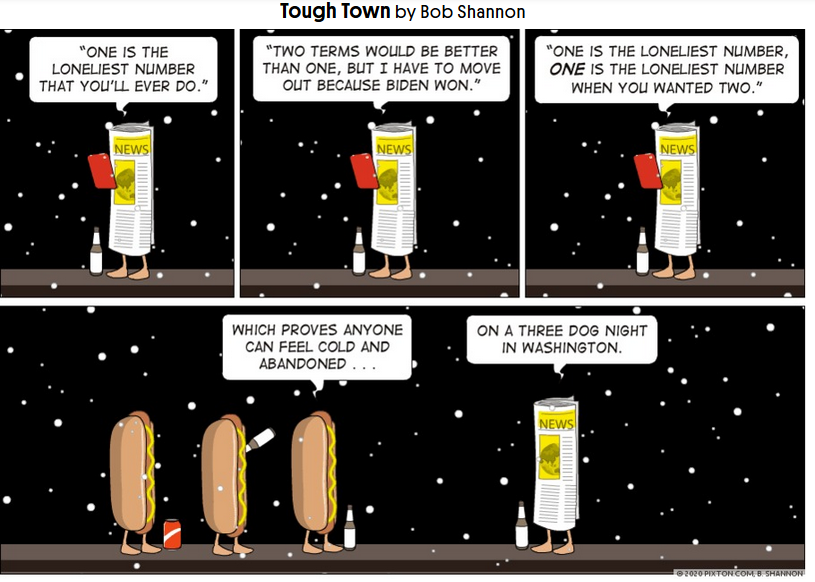
(Tough Town via GoComics.com)
.
.
We will get through this, somehow, but the wait for the solstice to roll over and the darkness to recede seems particularly tiring this year…
Thursday Evening Open Thread: Endless WaitingPost + Comments (158)

Come for the politics, stay for the snark.

We will get through this, somehow, but the wait for the solstice to roll over and the darkness to recede seems particularly tiring this year…
Thursday Evening Open Thread: Endless WaitingPost + Comments (158)
First of all – thank you all so much for your kind words about Penelope. I read each and every one of them. So much love for such a charming duck. My honest thought before I posted was, man, I’ve got to stop introducing you guys to my gang because it’s just too traumatic for everyone when we lose one. Which is inevitable when you have a house full of rescues of varying ages. As I said to a friend a few days before we unexpectedly lost Penelope Pearl, love is a risk, no doubt about it, but a risk well worth taking.
Now on to the festivities!
=====================
The other day I asked you to show me your holidays and happily, you responded.
First up from lurker Wendy:
Dorothy Winsor actually inspired this idea, when she shared this video:
Omnes sent me these wonderful memories:
My parents go all out for Christmas. Myriad decorations, ornaments gathered over the years, a top quality ham from a butcher shop, smoked salmon from the same place, homemade Boston baked beans (from the original Durgin Park recipe before they started putting too much sugar in them), homemade pate, a variety of cheeses, many types of homemade cookies (my mother has cut back over the past couple of years, there are still at least three kinds) and homemade vanilla custard trifle. Depending on the year, they can have anywhere from nine to twenty-five people come over. As the elder son and the only one who needed to travel more than a half hour to get there, I arrive a day or so early to try to help. Most of the time, I offered but got told that whatever is being done is “really just a one person job and I kind of like doing it.” So bartending and the two jobs I mention below are my contributions to the feast – plus my charm and and wit.

I am including a picture of the tree at my parents’ house from the morning of Christmas Day. As people are getting everything ready, one of my jobs was to bring out the presents and arrange them under the tree.

The other picture is a slightly blurry one of the vanilla custard trifle that my father makes every year. One of my other jobs on Christmas morning is to serve as assistant trifler as we assemble the thing.
The rest of Christmas Day can be a blur of snacks, opening gifts, and the whole dinner thing, but I really like that moment when the presents are under the tree, the trifle and other things are ready, the yard is covered with snow, and the rest of the people are just about to arrive. I can’t get there anymore, but at this moment I can still feel a bit of the magic of Christmas from when I was a child.
DavidG sent along cutie Morty in a bag:

I enjoyed this Rabbi this morning on one of the local news stations. He’s charming and full of great information.
Here’s my Dane-deer from 2004:
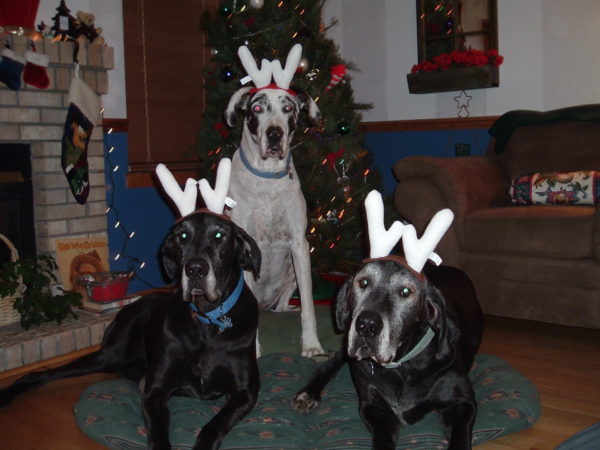
Shelby (Harlequin in back), Einstein on the left and Duncan on the right. Shelby was found running on the interstate, Einstein and Duncan were owner surrender – bonded brothers I fostered in an attempt to see if they could be separated. Those boys were my very first foster fails. ❤
And finally, if you missed this from Anne Laurie this morning, don’t miss it now. It completely turned my day around.
I’m still open to sharing more holiday memories, so email me (whats4dinnersolutions at live dot com). I do respond to each email, so if you sent something and don’t hear back from me, it means I did not receive it, so try again!
Respite open thread
Attribution is the process of assigning patients to groups.
This matters today because we have engaged in a decade long practice of attempting to transform care delivery in the United States by creating a proliferation of Accountable Care Organizations (ACO). An ACO is a clinical entity (a hospital system, a collection of physician groups etc) that agree to take a per-capita payment for a group of patients and gets a bit more flexibility to organize and administer their care. An ACO can profit if total cost of care at a given quality level comes in under the target. An ACO can lose money if total cost of care is over the target. The ultimate payer, such as the federal government for Medicare ACOs, can share some of the savings and losses.
One of the key questions in any ACO is who is the ACO responsible for? This is the attribution process. There are a lot of attribution algorithms out there that can split a universe of patients into groups of (ACO A, ACO B, not assigned) pretty well. However, one of the key questions is when does the ACO get the final list of patients it is financially and clinically responsible for? There are two choices. Retrospective attribution looks at the care performed on patients during a performance year at the end of the year. Attribution is based on who the ACO actually sees during the performance year. The finalized list is given to the ACO after the contract year is over. Prospective attribution looks at the care performed on patients prior to the start of the contract year. The ACO gets the final list on the first day of the contract year.
These are big choices to make. Prospective attribution will, by definition, miss people who move into the area or join the program for the first time in the performance year. Retrospective attribution will include people on the list who received care from the ACO provider network in the prior year but moved three time zones away at the start of the year, but the ACO is still responsible for their costs.
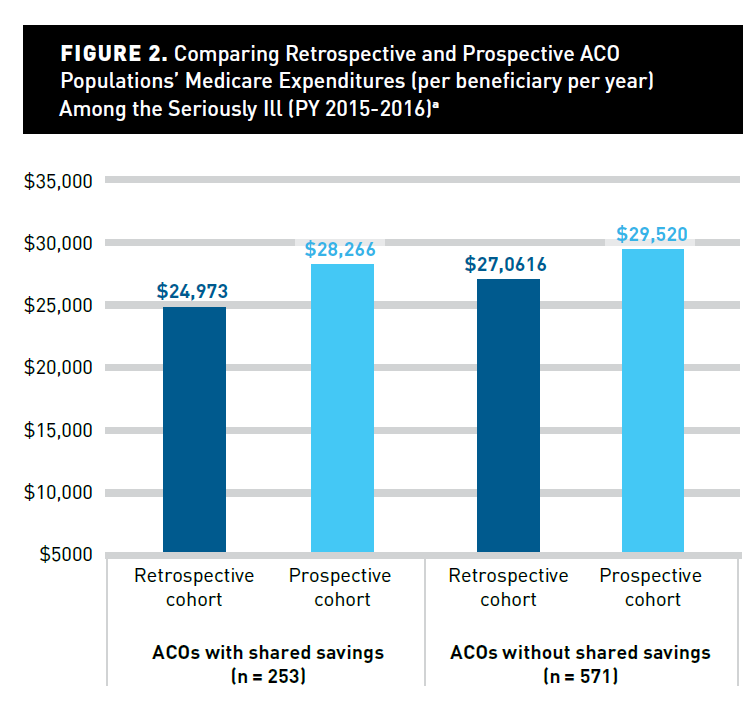
In a new paper at the American Journal of Managed Care led by Dr. Brystana Kaufman, a Duke Margolis colleague and friend, in work funded by the Gordon and Betty Moore Foundation, we simulated attribution to ACOs that are already in the Medicare Shared Savings Program using both retrospective and prospective methods to look at the differences in attributed populations for Medicare ACOs among populations defined as “seriously ill”.
There are big differences depending on what method is used.
Retrospectively assigned cohorts are cheaper than prospectively assigned cohorts.
Why is that?
Dying in the first 90 days of the performance year was associated with reduced odds of retrospective ACO attribution (odds ratio [OR], 0.24; 95% CI, 0.24-0.25) relative to beneficiaries surviving 270 days or longer. Similarly, hospice use was associated with reduced odds of retrospective assignment (OR, 0.80; 95% CI, 0.79-0.80).
Retrospective attribution needs certain types of claims in the performance year. Dying in the first three months of the performance year makes it difficult for the right types and number of claims to accumulate. Hospice in Medicare also does funny things to claims accumulation. The lack of claims makes assignment of individuals to an ACO using retrospective attribution difficult.
Prospective attribution picks up the soon to be dead as people who are in the last chunk of their life are likely to have significant utilization in the last full claim year of life. And it is this last full claim year of life that prospective attribution is looking at to assign people to an ACO. A prospectively assigned cohort will have much higher first quarter mortality in a Medicare ACOthan a retrospectively assigned cohort just because of who is included in the assignable universe.
So what does this mean beyond a half dozen geeks geeking out?
We’ve identified the start of a business case for specific focus on serious illness. If we want to make serious illness care more central to ACOs, then our choice of attribution methods matters a lot. If we want ACO leadership to be concerned about how the last year of life is treated in an ACO, then prospective assignment gives a very strong financial motivation to redesign care around the needs of this population.
Furthermore, a recent change to the Medicare ACO program allows for an ACO to choose which type of attribution they want. Previously, Medicare used retrospective attribution. Now an ACO may be able to make strategic choices to select the type of population that they think they are better at serving. This could have federal fiscal impact without changing overall care quality or efficiency.
(h/t commentor NotMax)
A candle or eight, in this season, is never amiss.
Speaking of lights in the darkness…
Biden plans to have the White House “meticulously sanitized” https://t.co/68TwqPJ3GF
— Blake News (@blakehounshell) December 10, 2020
Thursday Morning Open Thread: Happy Hanukkah!Post + Comments (224)
We continue at the Osaka Aquarium. The first five of these photos are from the big main tank, the rest from various exhibits towards the end of the trail.
On The Road – Captain C Goes to Japan: Osaka Aquarium 2Post + Comments (12)

One of several whale sharks in the tank.
U.S. records more than 3,000 deaths in a single day for the first time with vaccines nearing approval https://t.co/xgyqTHKIKq
— The Washington Post (@washingtonpost) December 10, 2020
COVID-19 Coronavirus Updates: Wednesday/Thursday, Dec. 9-10Post + Comments (49)
It will never stop being funny to me how terrified of cities the American Right is https://t.co/8xHepBa28Z
— Connor Wroe Southard ⚔️?? (@ConnorSouthard) December 7, 2020