
In case you’re new to Medium Cool, BGinCHI is here once a week to offer a thread on culture, mainly film & books, with some TV thrown in. We’re here at 7 pm on Sunday nights.
In this week’s Medium Cool, let’s talk about science in literature.
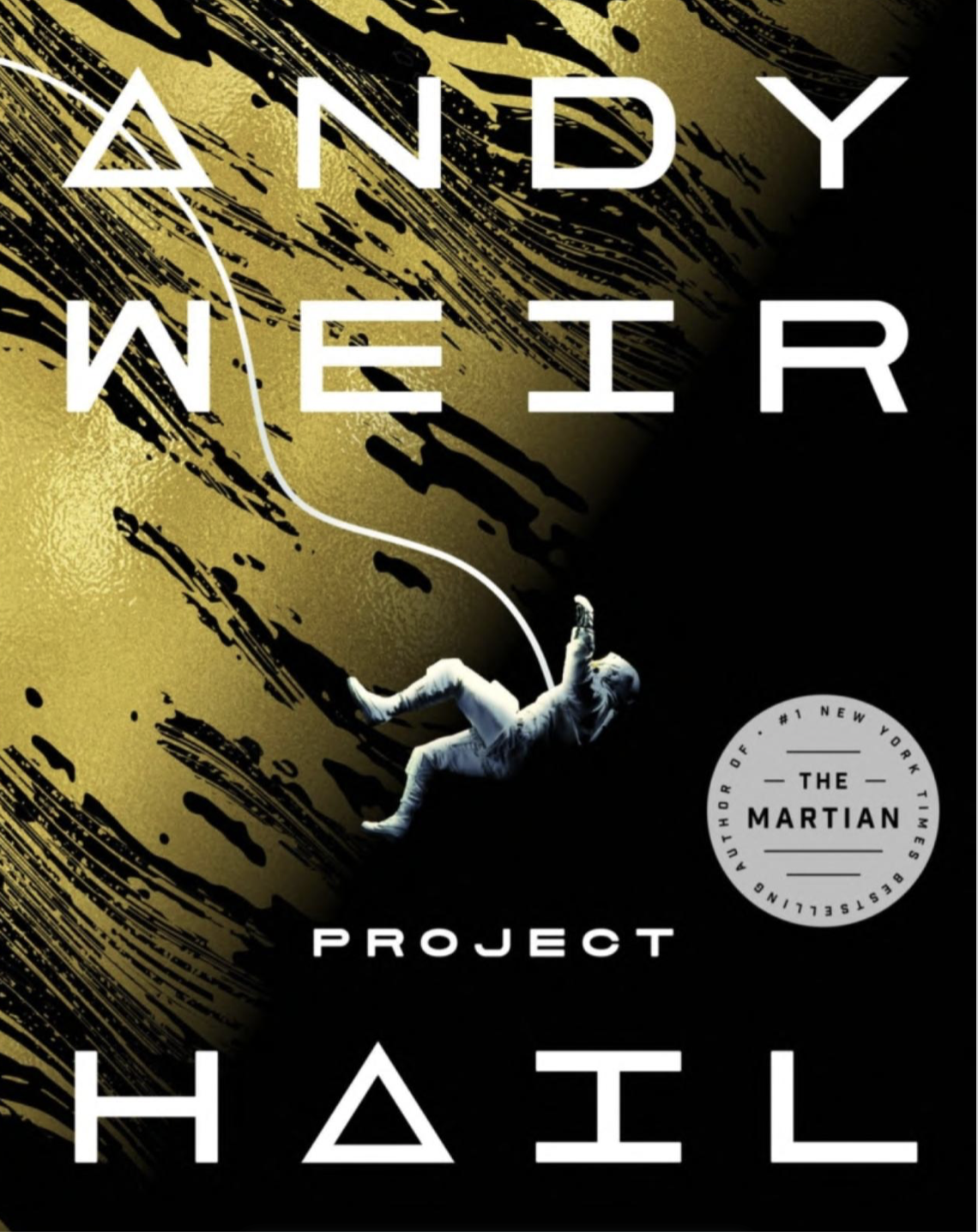
I just had a week off, and during my downtime read three books for pleasure: The Red Prince: The Life of John of Gaunt, Duke of Lancaster (2021, Helen Carr), Fugitive Telemetry (the most recent Murderbot novella, Martha Wells), and Project Hail Mary (2021, Andy Weir).
All three books are terrific, but I had a blast with Weir’s book. As you probably know, he wrote The Martian, which is full of science and engineering stuff, as a botanist stranded on the red planet has to use whatever he can to survive. No spoilers here, but Project Hail Mary has a similar premise, but with global stakes. It’s more ambitious and more fun. One of the things I loved about both books is that they spare no detail: everything gets explained without finessing how things work (physics, math, chemistry, biology, botany).
What other literary works pay such close attention to the details of the scientific process?

BGinCHI
I guess this song does.
piratedan
since I am an old, I’ll go ahead and cite some “hard science” olds that incorporate science thematically into their works….
If you’re into Military space opera, David Weber’s “Honor Harrington” series goes into quite a bit of theory regarding their hypothetical space travel thru the use of wormhole transits and usage in various bands of hyperspace and the stresses that they place on ship hulls and in the science of hypothetical weapon use and communication.
Larry Niven (Ringworld) goes into great depth for the use of planetary sized space ships and the type of engineering and power sources that would be needed to make this plausible.
As for incredibly old school, there’s H Beam’s Piper’s short story Omnilingual which treats the atomic table as a futuristic Rosetta Stone for the beginning of understanding an alien culture.
Mathguy
Greg Benford’s books were terrific at integrating reasonable scientific speculation with hard science. Two favorites: Timescape (won the 1981 Nebula) and Artifact. Timescape is about how to talk to the past to avert future disasters. Artifact does one of the best jobs of illustrating the research process in mathematics and theoretical physics and actually is a very entertaining read in spite of how that may sound.
piratedan
@BGinCHI: and this does too…
https://www.youtube.com/watch?v=3JdWlSF195Y
BGinCHI
@piratedan: These all sound very cool, and I’ve only read the Niven.
I have a huge appetite for details, as long as the story is also good. Same with heist and procedurals: the more detail the better.
BGinCHI
@piratedan: YES
BGinCHI
@Mathguy: Gonna check out Artifact. I feel like I might have read it, but damn, I’ll have to look. Sounds like my kind of thing.
BGinCHI
Neal Stephenson usually pretty good on this front too (maybe to a fault).
And I think William Gibson is underrated in his later novels for exquisite detail and observation. Particularly in Pattern Recognition.
CaseyL
I loved Hail Mary; the twists and turns in the story were delightful.
Just finished reading “How High We Go in the Dark,” by Sequoia Nagamatsu. Another description-defying novel: plague, space travel, plot loops, weird-yet-believable social shifts. An amazing book.
scottinnj
I find some of his work tedious, but the Mars trilogy by Kim Stanley Robinson is a standout work of hard sci fi. Think The Martian, over decades.
TheOtherHank
Crypotnomicon by Neal Stephenson is a fun read and does a great job on cryptology (not so great a job on the theory of money, but he got better about money in the The Baroque Cycle).
In Reamde he comes up with a way for an MMO to make money from and encourage the kind of gold farming that Blizzard does everything it can shut down. Plus it has a globe-trotting adventure story (with explanations of great circle navigation).
BGinCHI
@CaseyL: OOOH. Will check it out.
Weir isn’t always the best prose stylist, but damn can that guy spin a yarn. He makes it look really easy, and I’m here to tell you it ain’t.
JanieM
It’s been a while since I read it…and I’m not sure it’s quite what you’re looking for…and don’t judge it by the fact that the same author wrote “Eat, Pray, Love,” because it’s nothing like that.
But! I really enjoyed Elizabeth Gilbert’s The Signature of All Things. The central character is a female naturalist born in 1800. The science is important in the book, but not the central way it is in The Martian., which is the only one of those you’ve mentioned that I’ve read
Heidi Mom
My best-loved novel is The Voyage of the Narwhal by Andrea Barrett, in which a 19th-century corps of discovery sails off to polar waters in search of the lost Franklin expedition and fares almost as badly (not everyone dies) as that expedition did. Barrett writes beautifully about the joys of scientific discovery, the terror of the unknown, and the relationships between discoverers and discovered. She also writes about what I’d call “humans doing science, and the hazards thereof” in two books of short stories, Ship Fever and Servants of the Map.
J R in WV
I love the Murderbot series, from the very beginning. I just wish there were more long novels, and many more novellas. I recently re-read read the Baroque Cycle, about the beginning of the Scientific Revolution, with Newton and many of his contemporaries — thousands of pages, kept my attention off of Corona for longer than any other fiction I can think of.
A fascinating topic, I hope I get many more suggestions for interesting reads.
Oh, yeh, Vernor Vinge writes SF with lots of scientific thought invested.
BGinCHI
@JanieM: I wouldn’t make fun of her because once a month they back a dumptruck up to her house to unload a giant pile of money.
Gin & Tonic
I have to thank this blog (although I can’t remember who, exactly) for recommending The Martian, which kept me enthralled some years back on a LAX-MEL flight.
HumboldtBlue
Patrick O’Brian’s Aubreyad is chock-full of science, from the anatomy and botany of Dr. Maturin to the celestial knowledge of Capt. Jack Aubrey to the detailed descriptions of how a sailing vessel is equipped, manned and sailed.
Hell, one of the most celebrated online reviews of the books went something like, “I just read 20 pages about a rope. One star.”
O’Brian also features some of the quackery and pseudo-science of the day, such as turning lead into gold, various medical remedies shared among the crew, and the general superstitions held by seaman regardless of rank (whistling for wind, scratching a backstay for wind, never leaving port on a Friday).
O’Brian also peoples the series with actual scientists from the day and the Royal Society plays a key role in the books as well, as both Stephen and Jack are members.
If nothing else, you’ll learn about the weather gauge and why it’s so important in the era of fighting a sailing ship.
BGinCHI
@Heidi Mom: Good call. I’ve only read one of her books, but she’s a terrific writer. She’s another one who makes it look easy.
The Pale Scot
So everything you need to know about the war, politics, etc
The Psychic News Network
https://www.youtube.com/watch?v=JCBmBpUkHqM
“Ted Cruz has a podcast?” Gevalt!”
Watching video bores me, but there might be some nuggets in there
RSA
That was a clever story!
My thoughts: A lot of science fiction through the Golden Age included descriptions of technology, and it’s aged badly. Figuring navigation routes in space without computers, for example.
Stanislaw Lem put some serious thought into autonomous swarm-based systems, in Fiasco and other work, explaining how tiny self-recharging flying agents might cooperate to achieve goals and how they might be formidable enemies in wartime. His stories in The Star Diaries are sometimes comical, but often reasonably well-grounded, as in Tichy’s experience with time travel. It’s more philosophical than scientific, I think, but all good.
Fiasco has thematic similarities with Solaris, in the difficulties of communicating with incomprehensible alien minds. …which reminds me of the Strugatsky brothers’ Roadside Picnic, a good representation of incomprehensible technology. But the point is that these lack explanation, of course.
I was surprised to find, in Piers Anthony’s Of Man and Manta trilogy, an account of a life form based on cellular automata, which can be universal computers. The explanations were pretty reasonable.
billcinsd
A couple of sciencey songs
Gravity by Bruce Allen (who wrote the song for the Doom Buggies)
https://www.youtube.com/watch?v=Pk4TGBZFJlg
Make a Circuit with Me by The Polecats
https://www.youtube.com/watch?v=pWQS4P5M2AM
Sure Lurkalot
This recommendation is a bit different than these loved novels, but a favorite book of mine is The Age of Entanglement. From Amazon:
Excellent glossaries too.
NotMax
A varied trio of tomes which memory is still functional enough to provide.
Guns, Germs and Steel: The Fates of Human Societies, Jared Diamond.
Black Holes and Warped Spacetime, William J. Kaufmann III.
The Pencil: A History of Design and Circumstance, Henry Petroski.
NotMax
As for TV, while it is contrived it’s also a helluva lot of fun — the original Connections, hosted by James Burke.
dexwood
space
Space. The Python fellows.
E.
Moby Dick?
Math Guy
@TheOtherHank: I’ve read Cryptonomicon three times: I see a lot of myself in Lawrence Waterhouse. I’m sorry to say that I have been disappointed with Termination Shock and Fall.
Dahlia
Greg Egan is rather good but really rigorous.
Mike S (Now with a Democratic Congressperson!)
A book science fiction novel with lots of science detail and a great feeing of “realism” that I love is Orbital Resonance by John Barnes. When I’m reading it I really believe the Flying Dutchman asteroid/spaceship exists.
NotMax
Admittedly, I date back to the Golden Age days of Watch Mr. Wizard. Does that count?
Sure Lurkalot
Will also mention The Disappearing Spoon by Sam Kean about the elements of the periodic table. A rich and intriguing read.
Jacob Bronowksi’s dated but inspiring The Ascent of Man, chapters devoted to both scientific discoveries that changed the world of their times and the history surrounding.
BGinCHI
@E.: YES
NotMax
As for SF with an outr#233; yet internally consistent scientific foundation, Titan by John Varley, and both Arthur C. Clarke’s Rendezvous with Rama and The Fountains of Paradise.
Starfish
I liked the Murderbot book, but I got really annoyed at the Andy Weir book. It was very “look at me do math” while completely flubbing what an entity that was blind could and could not do. When you are blind, you cannot read labels in a dark space. So annoying.
zhena gogolia
@NotMax: Haha, what a memory.
ETA: Don Herbert!
NotMax
Coding fix.
As for SF with an outré yet internally consistent scientific foundation, Titan by John Varley, and both Arthur C. Clarke’s Rendezvous with Rama and The Fountains of Paradise.
MagdaInBlack
@BGinCHI: I’m really enjoying his (Gibson) newer books, esp. the one you mention.
Craig
Love Murderbot. Such a great character, and cool world.
marcopolo
@E.: Hah, after reading Moby Dick a person should be able to sign up as an experienced crewman on a whaler.
As for Kim Stanley Robinson, I’d say any/all of his books stick to real life science. In fact, I’m pretty sure I read an interview with him where he says when he wrote Aurora, which is about a generation ship sent to Tau Ceti, he wanted to write about a successful colonization effort, but after he did all the research he couldn’t bring himself to fudge enough detail to make it work. The entire process of writing the novel made him pretty depressed about the idea we’ll ever colonize another star.
I’ll also throw out the Salvation trilogy by Peter Hamilton. Some of it is set in the near future where quantum entanglement has been figured out and I found it pretty thought provoking all the uses that technology could be put to. The stuff that is set way way in the future gets a little woo woo but if we survive as a species for another several thousand years you’d have to believe we’d develop some technologies that would seem to us like magic now (hat tip to Arthur C Clarke for that thought). And, yeah, now that I think of him, AC Clarke’s stories tend to use workable technologies–first mention of a space elevator in his Fountains of Paradise
Edited to say: see NotMax got to ACC minutes before I posted this lol.
TKH
“George Letham, Arzt und Mörder” von Ernst Weiss which translates to “George Letham, physician and murderer”.
A novel about a physician serving time in a penal colony in South America discovering the fact that yellow fever is a mosquito-borne disease. I don’t know whether available in English. I read this during a phase when I read books by authors who perished in the holocaust. Stayed with me for more than 40 years.
marcopolo
@Sure Lurkalot: And then there is Primo Levi’s The Periodic Table. Not science fiction but amazing short stories. I highly recommend it. Here’s the wiki description:
Princess Leia
I love Alan Lightman, especially Einstein’s Dreams.
SiubhanDuinne
Dorothy L. Sayers wrote (with Robert Eustace) one non-Lord Peter Wimsey mystery, The Documents in the Case. As the title suggests, it is epistolary in form. I reread it a year or so ago. Its characters and situation are rather dated, but the science at the heart of the plot is intriguing, and a nice glimpse into what the intelligentsia were concerned with in ca. 1930.
A careful and expert mycologist dies a hideous death after eating mushrooms that he himself gathered and prepared. The poison that killed him, muscarine, is found naturally in some mushrooms, and can also be synthesised in the laboratory. The question is, did the victim inexplicably pick and eat toxic ‘shrooms, or was synthetic muscarine introduced into his stew?
It’s not the finest of her works (DLS herself thought she could have done a “much better job with it”), but IMO it’s worth reading.
RSA
I had hopes for Machines Like Me by Ian McEwan, being about AI and robotics, an alternative history novel, but it was a disappointment. No real detail, and I think his projections were just poor. The Turing character also didn’t come up to expectations.
SiubhanDuinne
@Princess Leia:
One of my favourite books!
Craig
@BGinCHI: I liked Pattern Recognition a lot. Fun story.
Neal Stephenson was a speaker at a conference I used to work at a few times. Real nice guy, he was talking about The System of the World and about writing Seven Eves, which has an amazing opening line. It was NBA playoffs time. I discovered he’s a big Houston Rockets fan, so we went to a pub down the street and watched a game.
persistentillusion
@SiubhanDuinne: I read it years ago, during my “read everything DLS wrote, except the Xtian stuff” and thought it a minor effort as well.
NotMax
@SiubhanDuinne
Mob enforcer and a Dame? A cornucopia of avocations!
;)
Yutsano
@NotMax: Burke wrote a book called The Knowledge Web which is Connections in literary form but with a neat twist. You can read the book forward to end or…you can reach the first number in the book and then jump to the page with the corresponding number and weave through time that way. It’s of course dated now but I recall it being a lot of fun.
Professor Bigfoot
“The Expanse” series; both media and novels. I find I have to do very little suspension of disbelief (although I do wonder how Birchers handled the UN becoming Earth’s government) with regard to technology and science.
I’m starting “The Peripheral” for the third time… I loved Gibsons taut, spare prose but I just can’t seem to get engaged with it.
I had to try twice to get into Stephenson’s “Anathem,” but once it got me I was well and truly got.
SiubhanDuinne
@NotMax:
Corn and avocados? Mmmm, salad!
(Years ago, I set my default keyboard to Canadian English. I’ve seen no reason since then to change it to boring non-U American English.)
Craig
The Last Watch by JS Dewes is pretty great. Military unit stuck at the edge of the universe when the rules of physics somehow are not what we thought they were.
Another Scott
Interesting topic!
Michael Crichton was a kook later in life (and maybe earlier), but I liked The Andromeda Strain as a kid. He seemed to try to get the science at least within spitting distance of being right.
Later on? Well…
From a speech at Caltech (around 2002):
All true!
But he took the wrong lesson from that.
Svante Arrhenius figured out that CO2 caused the Greenhouse Effect in 1896. The physics hasn’t changed, even if we have many more amazing gizmos than back then…
Thanks.
Cheers,
Scott.
NotMax
@SiubhanDuinne
Ah, so one might say your keyboard is Loonie tuned.
;)
BGinCHI
@Professor Bigfoot: Same here with Anathem. What a strange, wonderful book.
Pete Mack
An Alien Light, by Nancy Kress. This is an oldie but goodie: we find our heroine on a strange planet, with an orange sun and 72 hour days. She has recently been cast out of her (pre-technological) city for making anathema art, and is on her way to a mysterious walled city that appeared overnight in the wastelands….
Martin
David Brin. I thought Earth was quite well written.
Miss Bianca
@HumboldtBlue: Here to second PO’B’s Aubreyad in all these ways you mentioned. Also Stephenson.
Miss Bianca
@Starfish: I gotta get me some more Murderbot. Really enjoyed the first two I’ve read so far.
SiubhanDuinne
@NotMax:
?
Starfish
@Miss Bianca: It’s so much fun.
Iron City
Read Jared Diamond’s book. Entertaining, thought provoking. May in some areas be accurate. In his few examples touching aviation he proved he doesn’t know s%#t about the subject.
Starfish
@Iron City: Yeah, Jared Diamond and Malcolm Gladwell books fell into this category of “designed to make the reader feel smart” and “falling apart under closer scrutiny.”
Starfish
I used to read a lot of hard science fiction. Now it seems like I am reading more fantasy, stuff related to racial justice, and things that are non-fiction science.
For Black Sun (which is fantasy-ish), Rebecca Roanhorse did a lot of research into understanding blindness and how it worked. Her book was excellent, and I was reading this around the same time that I read Andy Weir’s book. Comparing how the two handled blindness made me realize how much Roanhorse really cared about it and did her research.
SamIAm
I believe there’s a term for this type of literature (one might say ‘genre’).
Science fiction, is that now a dirty word? I.e., why was this post labeled “science in literature” instead of “science fiction”?
Starfish
@SamIAm: With it being titled the way it is, we can insert The Gold Bug Variations by Richard Powers in here.
debbie
@RSA:
It was horrible. McEwan came across as an amateur. And I’ve liked his previous work.
RSA
@SamIAm:
Good question! I think it’s possible in principle to write literate about science that’s not science fiction, but it’s more difficult than with other domains. I’m remembering A. S. Byatt’s Possession, in which she creates fictional Victorian poets who were influential in their time, interacting with actual poets and contemporary movements (if I remember correctly). That’s much harder to do with historical science, in that scientists work to make lasting contributions to human knowledge that later contributions would depend on… Ideally, we don’t forget successful science in the same way that, say, artists and writers can be prominent and then fade from memory.
That said, I think it could be interesting to read fiction about a failed scientist, maybe along the lines of Salieri in Amadeus. He or she has a theory that just doesn’t pan out, and we learn about the ideas, the processes, successes and failures, etc. The thing is, we have lots of historical examples of just that, and they have the advantage of being true stories. A writer would need to find something interesting to say that didn’t happen to be derivable from the historical record.
ETA: There may be books like this—I’m not well-read about this sort of thing.
The only non-science-fiction fiction with a science theme that I can think of right now tends to be pedagogical and aimed at younger readers. “Here’s how things work,” for readers who don’t yet know how things work.
RSA
@debbie: Same thoughts here.
piratedan
@SamIAm: not all science fiction is “hard science” fiction. LeGuin, Cherryh, Butler, Zelazny all explored societal impacts set in futuristic societies (to mention but a few), I took the subject lead and example to represent the tone of the thread.
Kalakal
Alastair Reynolds does a great job of extrapolating hard science into the future. I love the Revelation Space universe. He has a thing about not using future tech that he thinks impossible eg FTL travel.
Other great proponents of hard SF are Robert Forward eg Dragon’s Egg, and Vernor Vinge eg A Fire upon the Deep and much older Hal Clement eg Mission of Gravity
Going back in time I was a big fan of Larry Niven’s Known Space.
bluefoot
I think Kim Stanley Robinson has improved over time. Despite sort of going off the rails, I enjoyed the “Science in the Capitol” trilogy. Though in some ways it hasn’t aged well at all – real life post-2016 has shown Robinson to be a total optimist about our ability to pull together as a society.
His “New York 2140” which showed how New York City might look as we cope with climate change. This might be my favorite Robinson novel.
I love the Murderbot series and also wish there were more and longer books.
The Lady Astronaut series is also great – alternative history of the space program.
Speaking of alternative histories, last year I read Gregory Benford’s “The Berlin Project” which postulates an alternative history Manhattan Project and a bomb ready by (IIRC) 1944. It was well thought out, I think.
PJ
This thread is dead, so all I will say is Primo Levi was one of the best writers talking about science (mostly chemistry but also physics) in fiction and non-fiction. The Periodic Table, where he relates specific elements to events in his life, is one of his best. Italo Calvino, another post-war Italian author, was also great at incorporating physics into his stories.
BellyCat
@NotMax: Agreeing with two of your three picks (Petroski and Diamond), I just ordered the Kaufmann book.
The joy of Petroski is the elevation of the mundane to the magical. Witold Rybczynski has a similar talent. Thoroughly enjoyed his “One Good Turn: A Natural History of the Screwdriver and the Screw”.
Uncle Cosmo
@TheOtherHank: I maintain that Cryptonomicon is the novel that would have been written by Thomas Pynchon in an alternate universe where he’d been hired fresh out of college by No Such Agency for their codebreaking operation. (Instead of Gravity’s Rainbow, probably.)
Uncle Cosmo
I spent a number of years reviewing SF for a major metropolitian newspaper, and people would say to me, Of course you write SF, right? – Hell no, I’d reply, and when they’d ask why not –
Tarragon
A couple of people have already mentioned Vernor Vinge…
What I like about his writing is that he has a way of writing that includes technology that feels feasible. His extrapolations of software in _A Deepness in the Sky_ and _Rainbows End_ stand up even when reading them as a practitioner.
His pure fiction inventions such as the bubbles in _The Peace War_ are rigidly thought thought out and internally consistant.
He can make his vision of technology really compelling. He wrote _True Names_ which kick-started a big effort in VR and virtual spaces and inspired the whole concept of cyberspace.
His essay _The Coming Technological Singularity: How to Survive in the Post-Human Era_ was the start of the whole singularity movement.
Tarragon
Charlie Stross does a lot of research to get his near future technology right.
His novels related _Halting State_ and _Rule 34_ are great examples. There was a 3rd planned but he cancelled it when technology and society advanced too fast and he wasn’t able to keep up:
Tarragon
Everything Peter Watts writes is hard science fiction around a kernel of speculation.