
• Menu
  • Skip to primary navigation
  • Skip to main content
  • Skip to primary sidebar

Before Header

  • About Us
  • Lexicon
  • Contact Us
  • Our Store
  • ↑
  • ↓

Balloon Juice

Come for the politics, stay for the snark.

“In the future, this lab will be a museum. do not touch it.”

No offense, but this thread hasn’t been about you for quite a while.

Putting aside our relentless self-interest because the moral imperative is crystal clear.

This chaos was totally avoidable.

Too often we hand the biggest microphones to the cynics and the critics who delight in declaring failure.

If you voted for Trump, you don’t get to speak about ethics, morals, or rule of law.

I would try pessimism, but it probably wouldn’t work.

Trump’s cabinet: like a magic 8 ball that only gives wrong answers.

Following reporting rules is only for the little people, apparently.

If you tweet it in all caps, that makes it true!

They were going to turn on one another at some point. It was inevitable.

… riddled with inexplicable and elementary errors of law and fact

rich, arrogant assholes who equate luck with genius

Let’s bury these fuckers at the polls 2 years from now.

If senate republicans had any shame, they’d die of it.

The republican ‘Pastor’ of the House is an odious authoritarian little creep.

“In this country American means white. everybody else has to hyphenate.”

Fundamental belief of white supremacy: white people are presumed innocent, minorities are presumed guilty.

I swear, each month of 2025 will have its own history degree.

Second rate reporter says what?

Not rolling over. fuck you, make me.

Wait, what?

Republicans: The threats are dire, but my tickets are non-refundable!

The real work of an opposition party is to hold the people in power accountable.

Mobile Menu

  • 2026 Targeted Political Fundraising
  • Donate with Venmo, Zelle & PayPal
  • Site Feedback
  • War in Ukraine
  • Submit Photos to On the Road
  • Politics
  • On The Road
  • Open Threads
  • Topics
  • Authors
  • About Us
  • Contact Us
  • Lexicon
  • Our Store
  • Politics
  • Open Threads
  • 2026 Activism
  • Garden Chats
  • On The Road
  • Targeted Fundraising!
old books on a desk with a quill pen

Authors In Our Midst

You are here: Home / Archives for Authors In Our Midst

BretH, Learning the Ropes

by WaterGirl|  March 29, 20262:00 pm| 17 Comments

This post is in: Adventures of BretH, Authors In Our Midst, Guest Posts

This is the 2nd installment of this story from BretH about being a motorcycle messenger in the 1980s.  In case you missed the first one, just click on the tag and you’ll see it.  Even though I was never a motorcycle messenger, it’s so fun to be taken back in time.

I had to learn how to ride. Really ride. I learned how to split lanes properly, and how, if the cars were really close together you could waggle your handlebars at just the right time to clear the mirrors of the cars on either side. This is when I fully understood just how perfect Nick’s motorcycle was, with its slender engine, and his handlebars narrowed by a few inches for more clearance.

One time when he saw the rear of my bike skid a little Nick leaned over and said “take a look at my front tire”. I had not realized it before but the tread on the front tire of his (and every experienced rider’s motorcycle) was severely scalloped from extremely heavy usage of the front brake. This was because it was the absolute fastest way to stop—good riders used it almost exclusively on dry pavement as the weight shift forward compressed the front forks, sending so much force down through the wheel that it was almost impossible to get the front tire to skid. They only used the rear brake for the final few feet of a stop, or when the road conditions were slippery. I practiced stopping by jamming on my front brake just like that until I lost the fear of skidding and eventually my front tire took on the same appearance.

I learned that riding in the rain was not all that much different from riding in the dry if the road conditions were normal—but a rider needed to observe the road ahead like a hawk. Were there depressions from heavy trucks that had collected water? Was it the first rain after a week or so, when the oil that had collected in the pavement was pushed up top? Was the road even slightly discolored? Was it at all shiny? Was there gravel? Nick informed me that Metrobusses were notorious for dumping a little slick fluid when cornering in traffic circles, and to watch out for that. As it was early summer, I did not learn at that time how to ride in the snow (indeed I wasn’t sure how it was really possible) but with winter a natural part of the cycle of seasons, and messengering being a year-round job that time would come, as we will see.

I learned that in order to make the fastest turn a good rider needed to briefly twitch their handlebars in the opposite direction, causing the bike to start leaning for the best grip, then continue the turn normally. I recall one day reaching a traffic circle heading into Georgetown and seeing a rider on an older but bright yellow BMW motorcycle pass me, do the little twitch to get the lean started then absolutely fly around the circle, with the left cylinder barely above the pavement, monitoring the angle of the lean by lightly dragging his left foot on the pavement. I would come to know that rider and those old BMWs very, very well, but that comes later in this story.

There were lessons to learn about other drivers, especially taxis. You noticed the turn of a head as someone glanced behind before making an abrupt turn. You knew that a hand up on the sidewalk meant that the first taxi around would make a beeline for that person no matter what lane they were in. You knew how mad drivers got when you split lanes between them as they were stuck in line at a red light but that soon they were far behind and in no position to do anything about it.

There was one time however when Pete and I, waiting at a light, heard loud honking and cursing coming from the cross street. One of our fellow riders had done something to absolutely enrage a driver who was standing up in his convertible shaking his fist and sputtering in rage. In some real danger of getting run down, or at least into a fight, the rider looked up and saw us, made a quick turn against the red light and nestled between us and from the newfound position of safety mercilessly mocked the motorist. Good times.
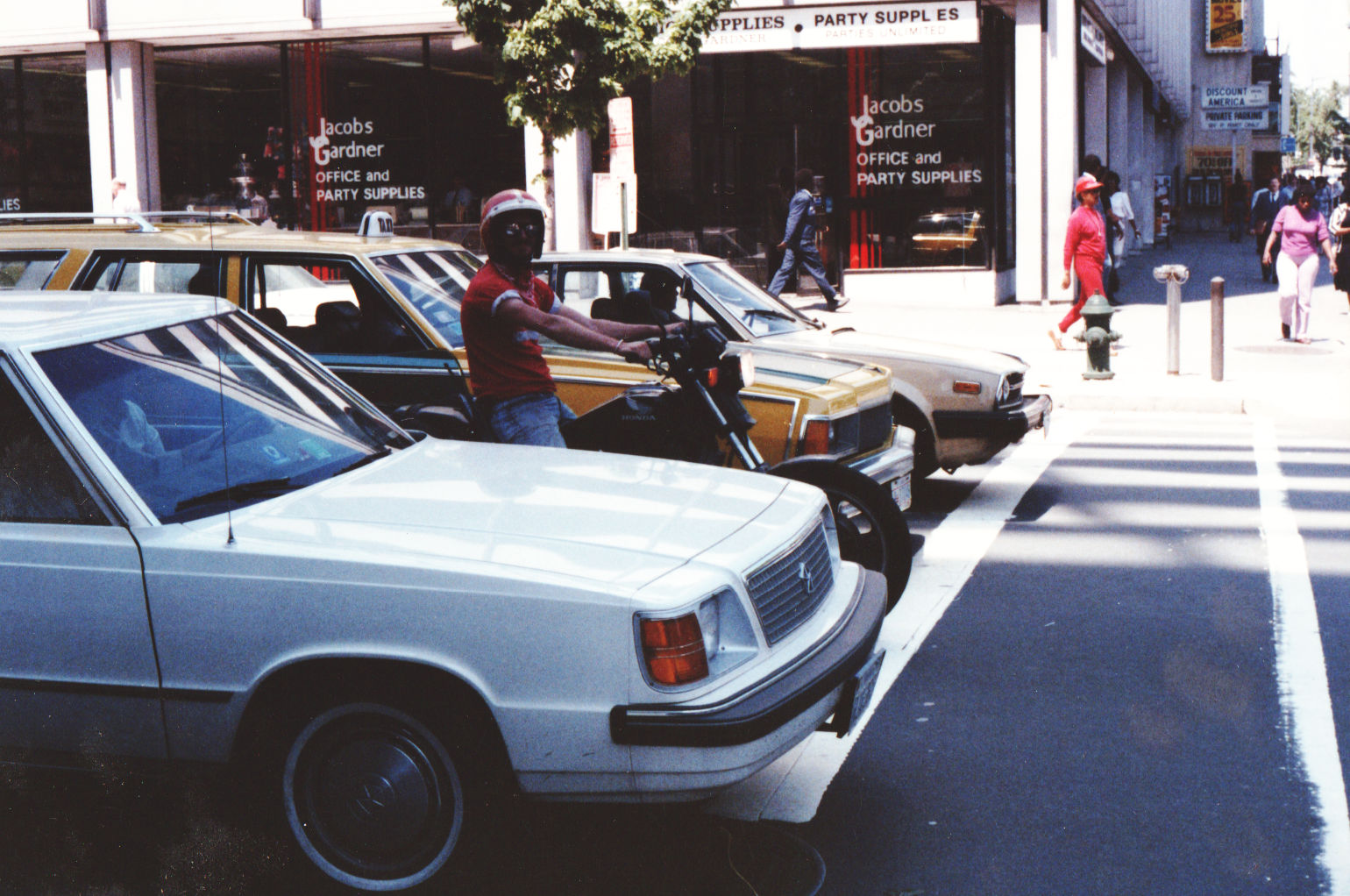
I had to learn something I had never considered up to that point: where the heck do you park your motorcycle 50 times a day to go inside a building to pick up or deliver a package, when the street parking was invariably full? The answer was, like so many things on the job, a delicate balance of convenience and legality and respectfulness of others.

The best parking space was next to the building just off an access road crossing the sidewalk leading to underground parking—out of the way of pedestrians and far from the street and the watchful eyes of the police and parking enforcement. The next best, and the one used most often, was to turn into one of those parking access ramps then do a little pirouette to park the bike right next to the street on the little semicircle of pavement there. The spot of last resort was between parked cars as one could never know when an unhappy driver might give your bike a little nudge on the way out of the smaller space you had allowed him.
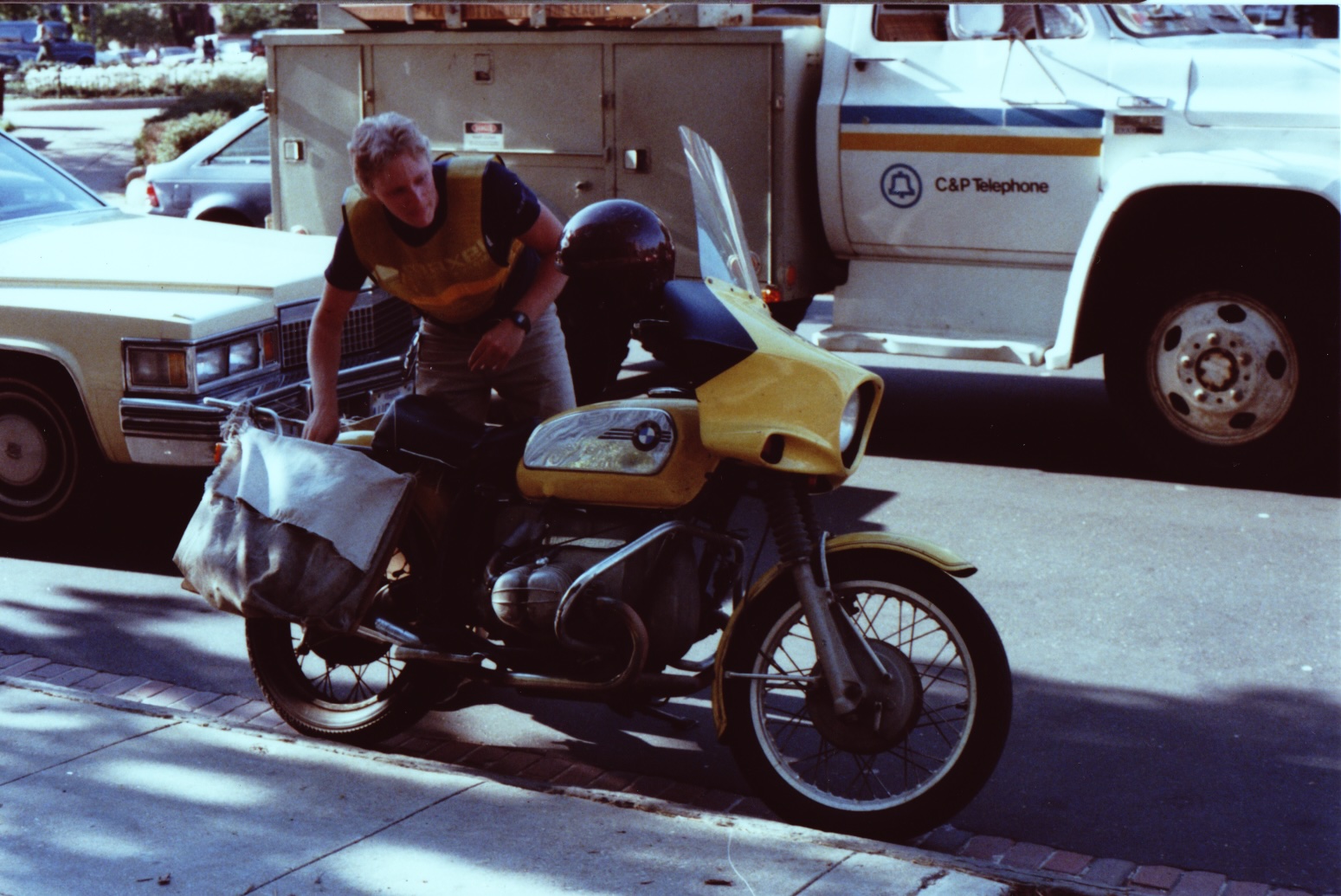
Using common sense and respect when parking was even more important among the various buildings of the Senate and House of Representatives. Messengers and the Capitol Police had an uneasy truce acknowledging that there were almost no “official” spaces for us to park, but because we were part of the necessary machinery keeping the offices humming, there were unofficial spots that everyone knew were OK, each of which had to be memorized. We were always somewhat on tenterhooks on Capitol Hill as we almost always went well over the speed limit, were somewhat cavalier towards “No Turn On Red” signs, and there were so many police around of various kinds: Park Police, DC Police, Capitol Police, GSA Police and even others.

To this day I maintain that motorcycle messengers, at least those that have made it through a year or so, are the very best riders there are. The sheer amount of hours we spent on our bikes in one year—in all kinds of traffic and weather conditions—was far, far more than the recreational rider might see in an entire lifetime. We were good, really good, and we knew we were part of a somewhat elite group. I could not escape the knowledge, however, that as good as we were, we also had to be somewhat lucky. On any given day, a mistake by a driver might end our career—or life, no matter how well we rode. Amazingly enough, although we all knew of incidents and accidents I do not recall any rider being killed while I was on the motorcycle.

Then there was everything we needed to learn about the job itself. Here I will take a minute to talk about Speed Service and what made it somewhat unique among messenger, I mean courier companies, because Big John took pains to call his riders that. He tried hard to give his company a sense of being exclusive, to distinguish it from the multitude of other delivery services in DC at that time.

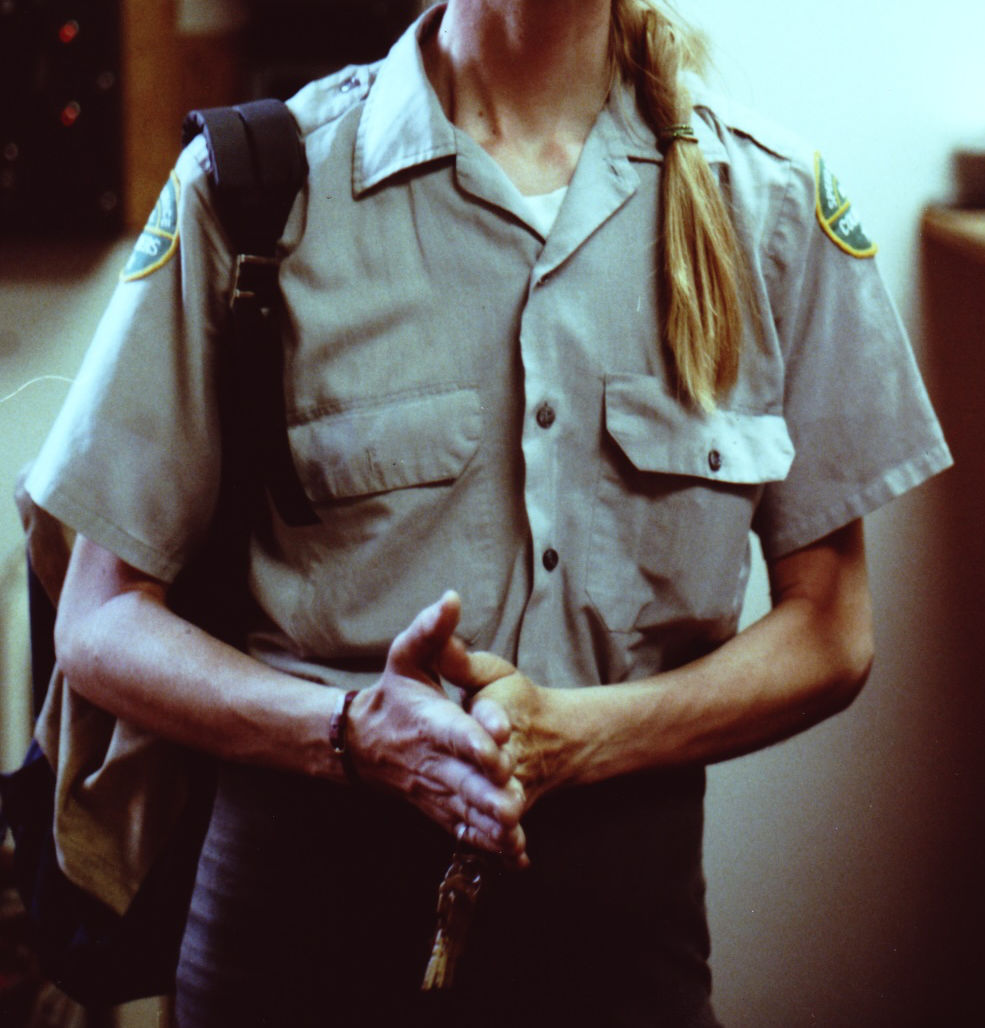
While most motorcycle and bicycle messengers wore whatever they wanted and indeed some riders looked like someone you would not want to meet in a dark alley, Speed Service riders were issued a gray button-down shirt, with tidy green patches on each shoulder with the Speed Service logo, and were expected to wear black pants to complete the outfit. Motorcyclists wore “shorty” white helmets with a black visor, like the police riders, and our radios were not clipped at our waist but slung over our shoulder with a microphone up near our mouth. At a quick glance we were indistinguishable from the many police services littering the DC area and that was likely part of the point of it: to generate less official scrutiny as we went about our business. Pete actually put this to good use one day when, after being cut off by an out-of-town motorist, he ordered the frightened driver to “pull over and wait here until I get back” before he spun off.
The job was at its core not a difficult one. Customers called the office needing a delivery and we would be dispatched to pick it up from one location and drop it off at its destination. But the simplicity of the task belied the complexity of making that happen efficiently. First off we needed the aforementioned 2-way radios. While it was possible to do the job using telephones (borrowing the phone in an office, and using pay phones, which were ubiquitous in those times), the inability to contact a messenger between calls to adjust the route or to add additional jobs made radios a necessity for any self-respecting company. I well remember my first few days and even weeks listening to the crackling chatter on the radio and thinking I would never get good at deciphering it. However just using the radio and indeed hearing it all day as other riders called in and were called by the dispatcher trained my ears to the point where the transmission could break up and I could be pretty sure of what was being said.

Riders were assigned a number, so the radio would come alive in little bursts all day long: “54”. “54 go”. “54, 10-7”. When I was a little younger I used to make fun of this during the CB radio craze in the ’70s: “Ten-four good buddy”. But there was a purpose behind these codes: conserving precious airtime while unambiguously conveying a message. I learned 10-7 meant “I am at the pickup spot or am ready to hear the instructions about the pickup”. 10-8 meant “I have picked up the package and am ready for more instructions”. 10-4 of course meant “I understand”, 10-10 meant “I have completed everything I had to do for the day”, and 10-19 meant the glorious “You’re done for the day, return to base”. With practice I was able to follow other messengers as they went about their runs, knowing when I might run into them to say hi or to share a little weed, or to just share some time with them while we waited for a new assignment.

Our customers were law offices, lobbying groups, major corporations, trade organizations and the like, and we carried literally anything that needed to get from one place in the city and suburbs to another in a short amount of time. Letters, large envelopes, artwork, court filings, airline tickets, law library books, press releases, gifts for Congresspeople and so much more all found their way into our saddlebags at one time or another.

A special set of Speed Service customers were the photography offices of The Washington Post, the Associated Press, and United Press International. One of our more interesting tasks was to go where news was happening and take film canisters directly from the press photographers to their offices to be processed and hopefully put on the front page of the newspapers. One time I was waiting for a photographer at the site of a shooting and standoff and was thrilled when he had to go use the restroom and told me to keep watch with his camera, mounted on a tripod with a huge telephoto lens, and take any photos I could if something happened while he was away.
 

BretH, Learning the RopesPost + Comments (17)

BretH, Taking a Leap of Faith in the Early 1980s

by WaterGirl|  March 21, 20262:00 pm| 43 Comments

This post is in: Adventures of BretH, Authors In Our Midst, Guest Posts

I’m not quite sure whether this is an Authors in Our Midst post or a guest post from BretH who was inspired to write it after his earlier story for us a few weeks ago about his time in New Orleans.

Either way, it’s a long story, so we’re breaking it up into 4 pieces, like a serial publication in the olden days.

From the first photo, I could swear that I knew BretH back in the day – so I have to ask, did we all know someone who looks just like BretH?

Becoming a Motorcycle Messenger in the Early 1980s

by BretH

There are times when events, circumstances and technology come together to create opportunities that peak, then fade and afterwards could never again be possible. This is a story set in one of those times, in the heyday of messenger services in Washington DC, long before cell phones, before e-mail, and even before the fax machine. For a few magic decades the growth of business and Government in the nation’s Capital coincided with improvements in radios and motorcycles to create a unique workplace for thousands of delivery riders, young and old. I was fortunate enough to have been a part of it.

It was 1981 and having recently returned from a time in New Orleans (link to previous post), I was living in Takoma Park, just outside of Washington, DC in the basement of the house I grew up in, and nearing the end of my second stint in college. I had left the South because life in New Orleans, while absolutely memorable, was quite chaotic, and I had soured on the city, its racism and antebellum past, and the dirt and heat, palmetto bugs and the dank smell that seemed to sit over the entire area for days on end.

I had decided to give college another go, this time at what I considered a soulless monstrosity: the University of Maryland. Unfortunately, once there I faced the same problem that had made me leave Antioch—I couldn’t really settle on what I wanted do with my life and was feeling the pressure of trying to figure that out in college. My best times were actually the five mile bicycle rides to and from school and hanging out in the quad with friends; the classes I largely forgot. After two semesters there, where I doggedly pursued an English degree with rapidly diminishing expectations it would ever amount to anything,

I was ready for another break and started checking the help wanted ads in the Washington Post (a real paper in those days). I couldn’t help noticing the several columns of ads for messengers—car, motorcycle and bicycle. The pay seemed great (later I would realize that those were the absolute top amounts that could possibly be earned by a great messenger who had a lucky week) and the ads offered flexible hours and no experience needed. I had been seriously riding and fixing bicycles since I was about 14 so that seemed like a job I could do well at—but for reasons that I can’t explain today outside of a sense of adventure and self-confidence gained by living in New Orleans, I decided I would become not a bicycle but a motorcycle messenger.

There were really only two things in the way of realizing this goal: I did not actually have a motorcycle, and aside from riding mini-bikes at friends’ houses I had no experience in riding one. But I had learned to drive on stick shift cars and as I said, was a very experienced bicycle rider so I resolved to not let that get in my way.

show full post on front page

Back in the classified ads I saw many motorcycles for sale but really only one I could afford at that point. So in a borrowed pickup truck I drove out to a rural area and found waiting for me a cute little motorbike with a sissy bar and raised handlebars and a large steel crash bar up in front of the engine to protect it (and me) in case the bike went down. It was rather like someone grafted chopper parts onto a petite Honda. Riding that little thing out the long dirt driveway to the road and back was not as hard as I had feared, the motorcycle seemed to run OK and did not appear to be missing any parts, plus the crash bar seemed like a really good thing, so we exchanged cash and I drove away with it in the back. A couple weeks later I had my license, a helmet, and had gained some basic experience riding it and was ready for the next step.

Interestingly enough, my best friend also wanted to become a motorcycle messenger, as I think he was graduating from the same University, having not taken a break like I had. Now Pete was in my eyes an experienced rider and actually had a Triumph Bonneville 750, a rumbling beast of a bike that left little oil droplets wherever it was parked. Together, we decided to try for one company called “Speed Service” that explicitly wanted motorcycle riders, because they offered a salaried position instead of paying by commissions from the jobs and had Workman’s Comp, which we figured might be very necessary at some point. We called and were told to show up the next Monday morning at 8am for a tryout.

Full of confidence and trepidation we headed into town that Monday and encountered what could have been a good or bad omen. Waiting at the front of traffic at one stoplight we were startled to see a small motorcyclist weave in between the lanes to join us at the front. We were doubly surprised when we found out it was a woman and she was a messenger herself. We declared we were just starting that day, and found out her husband was also a Speed Service rider. She wished us luck, which I realize now was more like “good luck, you’re really going to need it” as she had eyed what we were riding: Pete on his Triumph and me on my weird Easy Rider Honda.

We showed up at the appointed time to the little building on 14th street just above Logan Circle (then notable for the ladies of the night that prowled the area) and were given a short overview of the job and what was expected of us during our training period. Which in a nutshell was: follow your trainer, listen to them like they were the Voice of God, do everything they do in traffic and try your best to keep up because they are not going to wait for you. So we set off, Pete with one trainer and me with Nick, one of their senior riders, who had a most unusual motorcycle (at least to my novice eyes): a 500cc single cylinder Yamaha, slim as an arrow and outrageously fast off the line—really a perfect messenger motorcycle as it turns out.

I believe we had gotten no more than ten blocks away from base when Nick put on a burst of speed and I found myself behind a slow car terrified I would lose him. So in desperation I passed the car on the left, going into the empty oncoming lane to do so—when the car abruptly turned left into me, heading for a parking lot. I bumped the side of the car, went down and skidded to the curb, shaken but somehow unhurt. The crash bar had indeed done its job and although it was bent, the bike itself was also mostly undamaged except for a rear turn signal that was now hanging by its wires. The driver, who had not signaled his turn and was late to work, saw that his car was basically unscratched and accepted my apology and left me. Nick saw what had happened and after briefly checking to make sure I was in one piece basically said “you’re on your own now, kid” and continued on his way.

Utterly distraught and feeling like I had blown my one chance, I had no idea what to do except to limp back to the office in shame. I pulled into the back room which doubled as a work area where I was met by the owner of Speed Service, Big John himself, and Bruce, an ex-rider, dispatcher and general handyman, neither of whom were in the least surprised to see me. I confessed what had happened, expecting to be fired on the spot, and they asked me the fateful question: would I be willing to give it another try? And there began my real education of how to be a motorcycle messenger.

“First off, we gotta do something about your bike.” We got my motorcycle up on the work platform where two of them looked it over and tut-tutted and reached for the socket wrenches. Off came the sissy bar. Off came the raised handlebars and Bruce rummaged about in bins until he found a replacement pair, barely raised and cut down a little to be narrower than stock. New bars on, they turned their attention to the crash bar and it was unceremoniously removed. I was told that they had seen me initially pull up and knew the bar would be a problem because in order to do the job the bike had to be as narrow as possible because it was absolutely essential to “split lanes” as we had seen the female rider do earlier. If I went down from now on I might expect to scrape the tank or the sides of the engine but apparently that was not considered anything I should be concerned about.

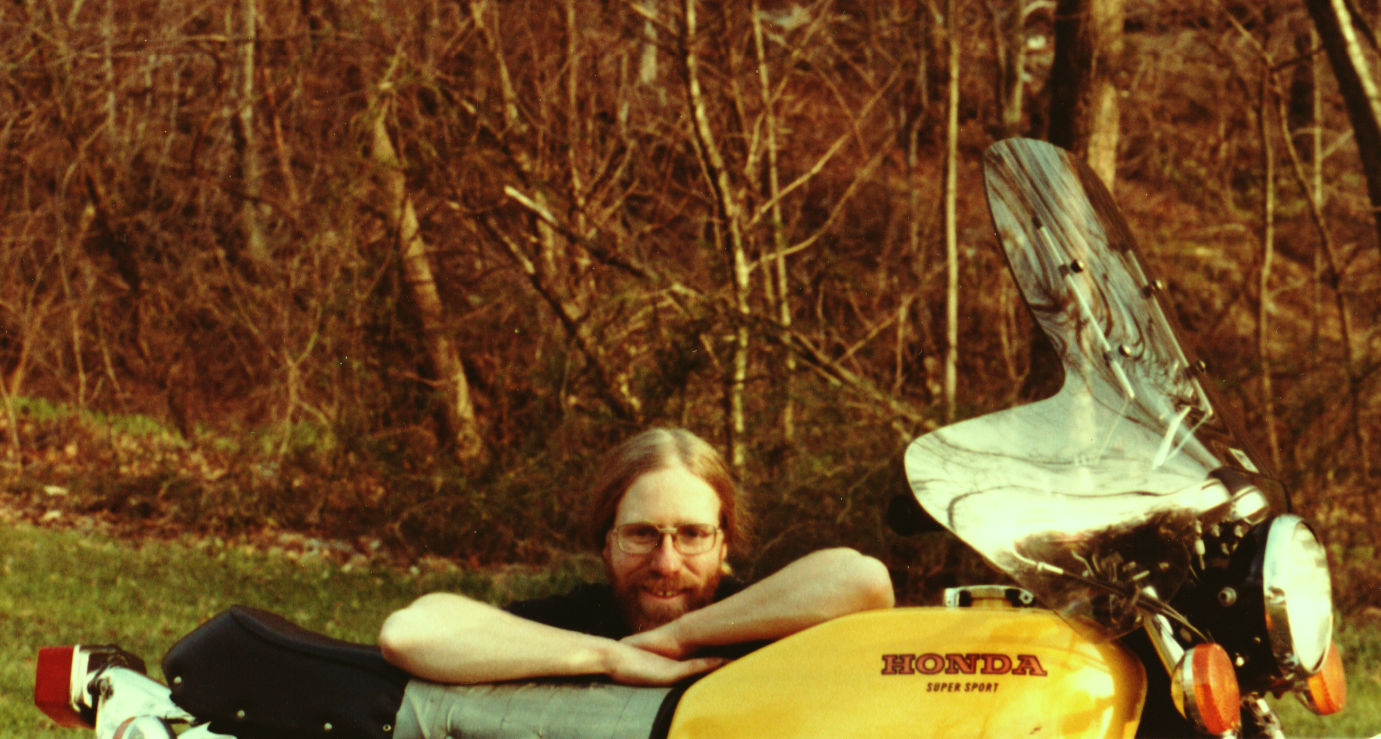
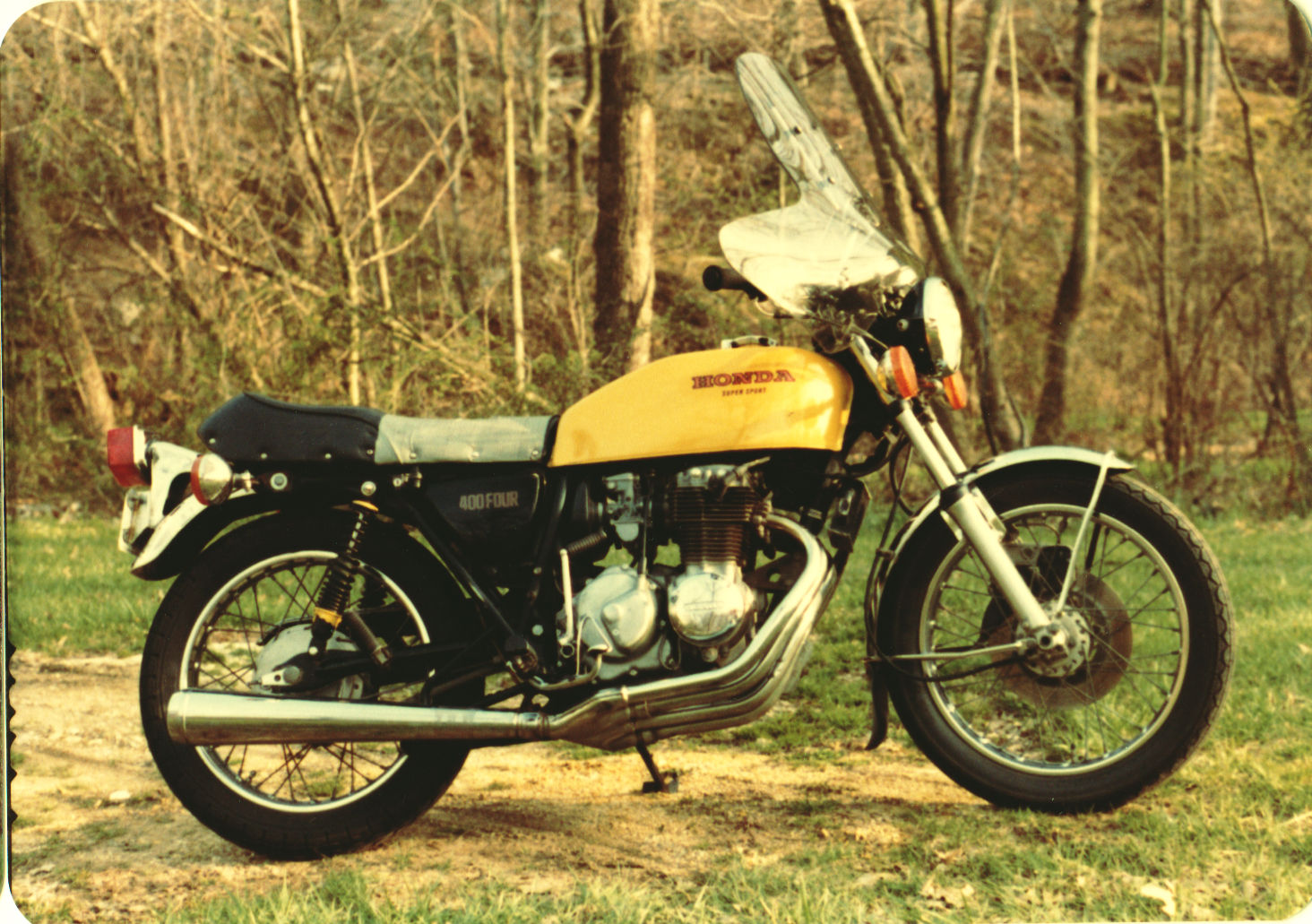
A little about my particular motorcycle. It turns out that I had unwittingly gotten a pretty good bike, well suited for the job. It was a Honda 400cc four-cylinder Super Sport, which these days is quite the collectors item with die hard fans who truly appreciate this early little sport bike. The engine buzzed like a sewing machine as it was happiest running at high revs, and had a six-speed gearbox which, once you knew how to work it, made the bike a snappy little thing. The exhaust was unique, a glorious four-into-one that was really a work of art. The SuperSport was pretty much bulletproof as well, with the only weak spot being a tendency to eventually leak oil from the cylinder head gasket as the air-cooling was lacking for the middle two cylinders.

My newly stripped-down motorcycle made ready I was told to come back the next day and Nick would take me out again. That I did, and whether he was told to be more mindful of me or whether the initial trial by fire and my reluctance to quit signaled a seriousness that he respected, apart from being a top-flight courier, Nick proved to be a patient and detail-oriented teacher. And I hadn’t realized just how much I would need to learn.


BretH, Taking a Leap of Faith in the Early 1980sPost + Comments (43)

Authors In Our Midst – Chemiclord

by WaterGirl|  January 10, 20262:00 pm| 54 Comments

This post is in: Authors In Our Midst

With all the craziness going on in the world, it’s tough to find a time when our Authors and Artists posts can really get their moment in the sun. So I am re-posting this from last week!

Tomorrow we have an artists post at 4pm, hoping folks can take time for that.

It’s easy for the arts and literature to be squeezed out because of the onslaught of awful current events, but I suspect we need them more than ever.

If you would like your talent featured in Authors in Our Midst or Artists in Our Midst, just send me an email message and we’ll make it happen. Don’t be shy! I have no more Artists or Authors posts in the queue, so please get in touch if you would like to be featured.

Let’s give a warm welcome to Chemiclord!

Hello, denizens of Balloon Juice!

I’ve never been terribly good at “selling myself,” so I apologize ahead of time if this comes across as awkward and unpracticed.

Because it probably is.

My contribution to the class is one that had been cooking since 2016, when an artist friend dropped me a link to his Tumblr, something that he wondered what I would do with.

https://www.tumblr.com/fredrin/149495608947/sometimes-when-freesketch-i-sorta-dont-know

(Here is a link, if any are curious.)

What was I, a failed sportswriter wannabe turned freelance writer, supposed to do when challenged with a prompt such as this?  Of course, I jumped right up… and did nothing with it for about three years, because I was busy finishing a series he had already contracted me to do.

But when I finally did get to thinking about it, I had just finished an article about Peter Thiel and his attempts at extending his life, and so the premise of this book took shape, based on the question, “What would happen if some wealthy billionaire actually figured out a way to become effectively immortal?”

The answer to that question is fairly easy to surmise, “Nothing particularly good.”

And it all culminated with the release of the first book in the Transcendent Series, The Girl in the Tomb.

Authors In Our Midst – Chemiclord

A story about the aftermath of billionaires destroying the world for their own selfish gain… just as billionaires in real life started actively destroying the world for their own selfish gain.

I have never been a man of perfect timing.

The story itself starts roughly four thousand years after the “Metal Gods” nearly annihilated the world, and the survivors have started to flourish again, and start demonstrating the age-old trait of humans to forget the lessons of history.  Tensions between the various groups of humanity rise as old grudges emerge, and in that soup of unrest, a rebellious archaeologist discovers one of those old gods in a state of stasis.

And of course, winds up waking her up.

I don’t normally like to toot my own horn about my own projects, I prefer to let them speak for themselves for the most part, but this one has impressed someone out there enough that it was nominated for the Indie Ink Awards for 2025, and I’ll admit that while I don’t write for such recognition, it’s nice to receive it nonetheless.

So, if any of that interests you, I invite you to my website, where you can find links for that, and all my other books in my (surprisingly large) bibliography.  Or if you want to just skip all my meanderings entirely, you can go straight to this Amazon page.

Authors In Our Midst – ChemiclordPost + Comments (54)

Authors In Our Midst – Jennifer Schiff – An Obsession With Murder

by WaterGirl|  December 20, 202510:00 am| 42 Comments

This post is in: Authors In Our Midst

If you would like your talent featured in Authors in Our Midst or Artists in Our Midst, send me an email message.  Don’t be shy!  I have no more Artists or Authors posts in the queue, so please don’t hesitate to  get in touch if you would like to be featured.

Let’s give a warm welcome back to Jennifer Schiff, who has a new book to tell us about.

This is take two because the one last week wasn’t on top for long, and that is the second time that has happened to J. when we have featured one of her books.  Having an Artist or Author or guest post can be a great opportunity, and I feel bad if you guys don’t get your moment in the sun after you’ve spent the time to put something together to share with us.

So without further ado…

📚

Hi again, fellow Balloon-Juice readers!

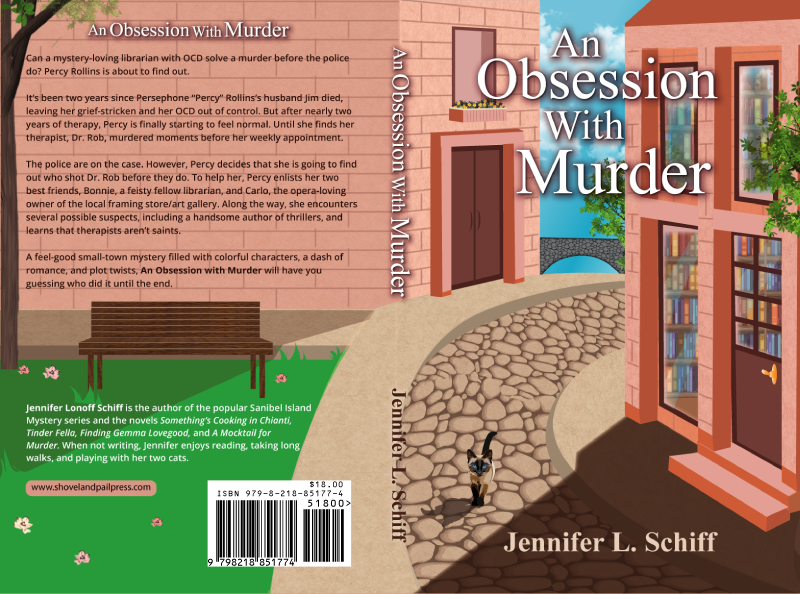
I’m excited to announce the release of my new novel, An Obsession with Murder, the first book in a new mystery series set in New England.

THE PLOT: The main character/amateur sleuth is Persephone “Percy” Rollins, a mystery-loving, recently widowed librarian with OCD and a 20-year-old daughter. (Think Monk or The Maid meets Gilmore Girls.) Percy’s been getting grief counseling and help for her OCD from Dr. Rob, a local therapist she has come to rely on.

So when Dr. Rob is found shot dead in his office just before her weekly therapy session, Percy takes it upon herself to solve his murder—with the help of her two best friends, Bonnie, a feisty fellow librarian, and Carlo, the opera-loving owner of the local framing store/art gallery. As she searches for answers, Percy encounters several possible suspects, including the handsome widowed author of bestselling thrillers.

Can a librarian obsessed with murder solve the case before the police do? Read the book to find out!

(click to read the back cover)

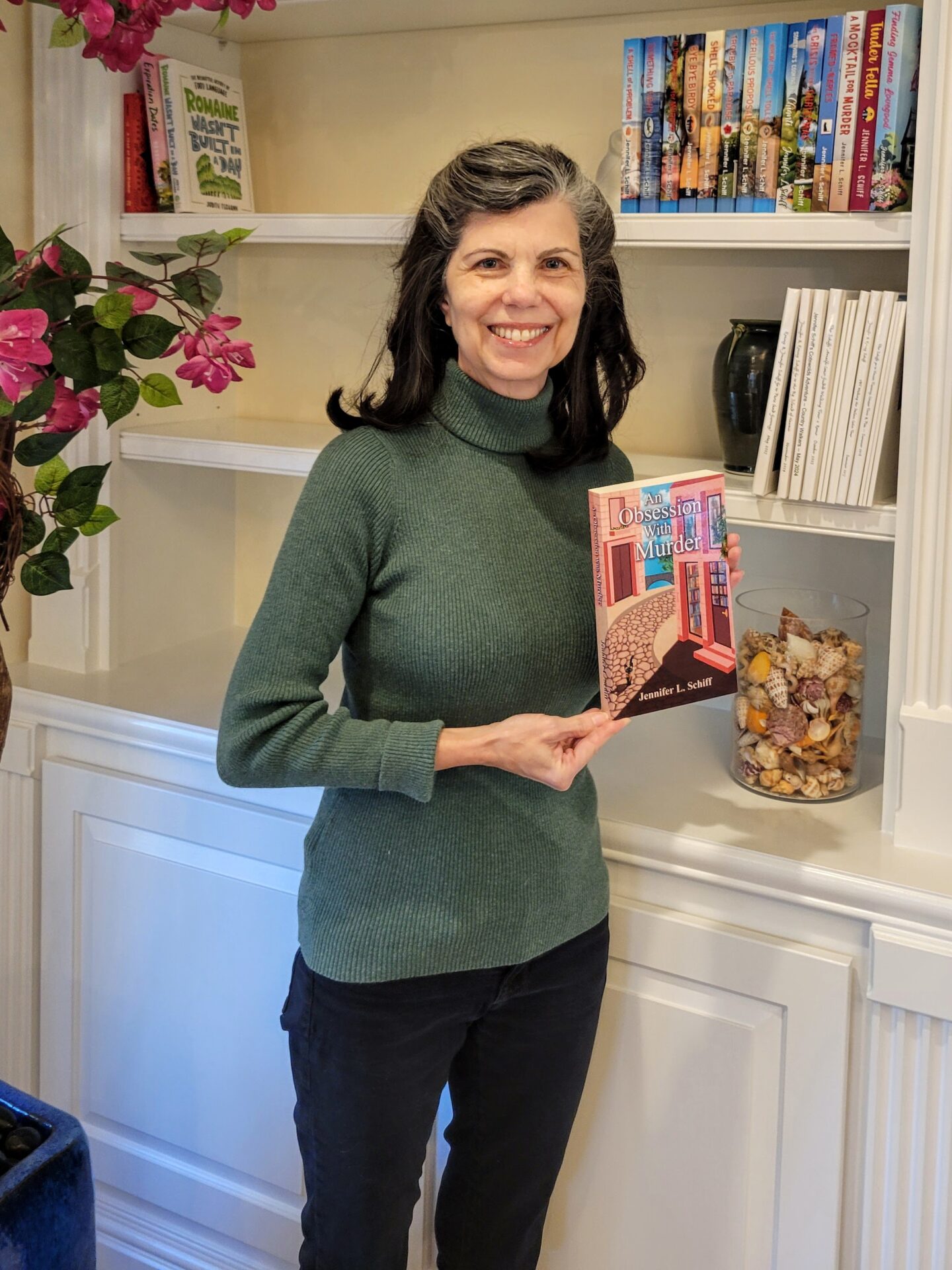
Authors In Our Midst – Jennifer Schiff – An Obsession With Murder 1

As with all of my books, you can find An Obsession with Murder on Amazon (paperback, Kindle, and Kindle Unlimited), Barnes & Noble, and your favorite online bookstore, as well in select bricks-and-mortar shops. NOTE: Any bookstore or library can order my books (via the Ingram Company). So if you want your bookstore or library to carry Obsession or any other book, just ask them.

Authors In Our Midst – Jennifer Schiff – An Obsession With Murder 2

And if you enjoy the book, please tell your friends about it and consider leaving a review or a rating. Thanks!

Authors In Our Midst – Jennifer Schiff – An Obsession With MurderPost + Comments (42)

Authors In Our Midst – Randall Luce – The Cost of ‘Good Trouble’!

by WaterGirl|  October 5, 20251:00 pm| 56 Comments

This post is in: Authors In Our Midst

If you would like your talent featured in Authors in Our Midst or Artists in Our Midst, send me an email message.  Don’t be shy!  I have no more Artists or Authors posts in the queue, so please don’t hesitate to  get in touch if you would like to be featured.

Let’s give a warm welcome to Randy Luce, who has a book to tell us about.

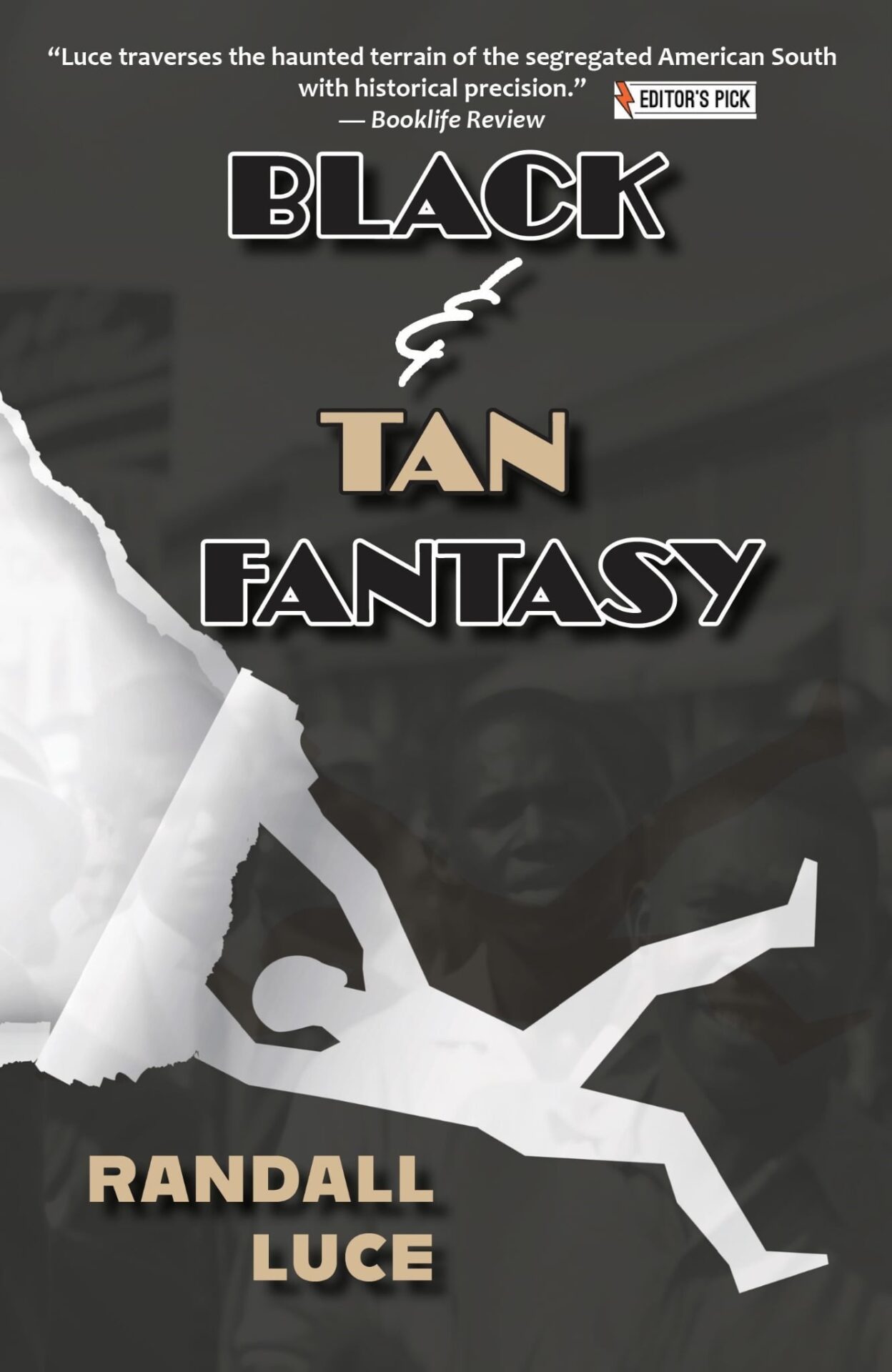
Hello.  My name is Randall (Randy) Luce.  I’m a long-time lurker.  I recently had a novel published, named Black and Tan Fantasy (after the Duke Ellington/Bubber Miley composition) that I highly recommend for your reading pleasure.  Most of the action takes place in the Mississippi Delta during the early days of the Freedom Movement, and follows, in alternating narrative lines, two protagonists, Harry Wilbourne and Aleck Sharpe.

From a BookLife (Publisher’s Weekly) review:

In the 1920s, Harry Wilbourne—a white man who rescues a Black woman, Geneva, and her children from a fire—does more than commit a heroic act. As Luce demonstrates, with pained clarity, Harry steps out of whiteness itself, launching himself into a racialized exile. In Chattanooga, among the very people he tried to save, Harry becomes a stranger—never quite accepted, never fully at home, his journey exposing the cost of crossing lines in an era when the rules of identity are rigid and unforgiving. From that wrenching setup, Luce fast-forwards to the 1960s and the Civil Rights Movement, as a young Black activist named Aleck Sharpe, raised in the shadows of racial violence, joins the Student Nonviolent Coordinating Committee—but bristles at the doctrine of nonviolence, with Mississippi’s white supremacy chafing against everything he’s seen and felt.

Luce traverses the haunted terrain of the segregated American South with historical precision, interrogating the complex construction of racial identity and the binary ways—violence and nonviolence—people are driven to pursue justice.

BookLife gave the novel its Editor’s Pick designation, reserved for books of “outstanding quality.”

📚

This novel is one aspect of my life-long attempt to understand this country I was born and raised in.  I grew up in Southern California, in a state (California) and among towns and cities (Los Angeles, La Habra, Pico Rivera) that have Mexican origins and Spanish names, during an era of hyper-segregation.  So, I grew up surrounded by white Anglo-Saxon Protestants (just like me), with nary a person of color around.  I never had occasion to consider how odd that was.  I liked music, and the music I grew up listening to—rock and roll—I had no idea just how all mixed up it all was—Black, white, Hispanic.  Nobody told me.  Long story short, to me my childhood life, culturally and socially, was pleasantly bland.

So, how do I get off writing a novel that features Black characters?

In my late teens, two things happened.  I heard John Coltrane on the radio, and Louis Armstrong died.  John Coltrane’s music blew me away.  I’d never heard anything so exciting.  I had no idea who he was or where he came from.  And I wanted to hear more.  When I got a record player as a going-to-college present, one of the first albums I bought was The Best of Coltrane, on Impulse Records.

As for Armstrong, when he died I was surprised to read in the newspapers that this genial entertainer, who I’d seen many times on TV, was a musical genius and one of the most important musicians of the twentieth century.  I wondered why I hadn’t known that before.

When he appeared on television, why hadn’t he been introduced as the genius he was?  Why hadn’t he been allowed to demonstrate the full extent of his musical talents?  I decided I had to hear the music that marked him as a genius.  When I got a recording of his Hot Fives and Hot Sevens, his music sounded just as timeless as Bach’s and Beethoven’s.  I’d known that there was this genre of music called jazz—you know, like Dixieland—since I’d been a child, but I’d had no idea that jazz was about geniuses like Armstrong and Coltrane, so I started to learn all I could about this music and the musicians who played it.

That led me to discover other aspects of Black culture, and how it lives in the very center of the American experience.  We all know the quintessential American story, the type where, say, Abraham Lincoln is born in a log cabin and becomes president.  But Frederick Douglass’ journey of self-creation was no less remarkable and no less American.

Long story short: I learned you can’t know America without knowing about all its people, and so much of that information is hard to find, and is doled out only occasionally and in very small doses.  I came to feel that I’d been cheated out of something that was my, and everybody’s, due—a full knowledge of my country’s cultures and history and people.  I went on to do graduate research in the Mississippi Delta on local Black and white political activity, particularly how local criteria of authority among Blacks and whites affected, and was affected by, the Civil Rights Movement.  Black and Tan Fantasy came out of that research, and years of reading and thought.

So, the way I look at it is, if I was going to write a story that takes place in America, how could I not include Black characters?

Here’s a .pdf file of the first chapter, if you’d like to read it. BLACK AND TAN FANTASY First Chapter

You should be able to order the book at your local bookstore.  It’s also available at Amazon and at the publisher’s (GladEye Press) website.

I’d be more than willing to answer questions from any and all Jackals that might find this interesting.


Authors In Our Midst – Randall Luce – The Cost of ‘Good Trouble’!Post + Comments (56)

So Very Small (Self Aggrandizement Post)

by Tom Levenson|  April 22, 202512:55 pm| 122 Comments

This post is in: Authors In Our Midst, Books, Open Threads, Science & Technology

Hey, everyone…

You may have noticed that I’ve been conspicuous by my absence lately. (Narr: for “lately” read “the anthropocene.”) It’s been for a variety of reasons–some health stuff (now OK, thanks for asking); some mental health/self care as we confront the barbarism of the US today; and, more than anything else, seemingly inexhaustible deadline pressure.

Some part of that pressure is finally getting its release–which is the longwinded way of saying that the publication date for my new book So Very Small is upon us. One week from today (4/29) in the US; 5/1 in the UK. (UK info here.)

So Very Small (Self Aggrandizement Post
(Venice) Philosopher with book by Guercino

It’s good, I think. Early readers and reviewers seem to think so. Publishers Weekly and Kirkus both gave it starred notices, which is very comforting, and the blubbers  blurbers (I do love this autocorrect flub) wildly exceeded my imagination.* For example:

“So Very Small is very large and fascinating. Thomas Levenson expertly combines storytelling and big questions, most notably: Why not? Why wasn’t the germ theory of disease formulated 200 years earlier? Why, in general, are huge scientific discoveries delayed until they happen? This is exactly the sort of book that a literate citizen, keenly interested in science, reads for enlightenment, perspective, and fun.”—David Quammen, New York Timesbestselling author of Breathless

(Quammen is one of my writing heroes, so when he has something nice to say about my work, I kvell.)

One more:

“By peering through the lens of the modern germ theory, and our protracted battle with disease, Levenson has crafted a vivid, engaging, and timely reminder that we are not as omnipotent nor as clever as we often believe ourselves to be. So Very Small is a deeply researched and thoughtfully compelling exploration of our successes, failures, and precarious future with deadly pathogens.”—Timothy C. Winegard, New York Times bestselling author of The Mosquito and The Horse

I blush! There’s more like this at the Random House link. ;-)

As these two blurbs indicate, So Very Small is ostensibly a history of the discovery that microbes cause infectious disease. The story of the results that added up to germ theory is usually told as a tale of a compressed explosion of discoveries in the second half of the 19th century, but when I started on this project I found myself wondering about what happened to get to that moment. Microbes were first observed in the 1670s, after all–and yet it took almost exactly 200 years to get to the first conclusive demonstration that a particular bacterium lay behind a specific diseases (Robert Koch’s identification of B. anthracis as the pathogen causing anthrax, achieved in January 1877.)

As I tried to piece together why it took so long to get from point a to point b, I realized I was onto a bigger story–one that extended forward from the discovery years to the present day. I argue that the biggest obstacles to making the connection between microbes and disease wasn’t scientific. They were cultural, religious, and social. And those same roadblocks obtain (in different form but recognizably kin to the ideas that went before) still–and help explain why so much of the benefits humankind gained from the insights of germ theory are now at risk.

I have to say that when I started to work on this book (first discussion in 2012; work in earnest starting in ~2021) I had no idea it would be so timely. I wish it weren’t. But with RFK Jr., wreaking havoc on the US public health and biomedical research infrastructure, So Very Small definitely looks forward by looking back.

If y’all are interested, I’ll ask Watergirl if we can set up a post and/or Zoom book talk sometime after the pub date. In the meantime, if you’d like to hear more about it, the excellent Sean Carroll and I talked about it (at length, but what else would you expect from me? ;-) on his Mindscape podcast.

That’s enough. To make up for such naked self-promotion, I promise a good food/cooking post a bit later in the day (maybe tomorrow if the rest of the afternoon eats me alive.)

And with that…this thread is as open as a Hesgeth Signal chat.

*The question of blurbs and blurbing is a vexing one, and some publishers (and lots of authors) want to get away from the practice. Happy to talk about this issue in another post if there’s interest.

Image: Guercino, Philosopher with book, 1635

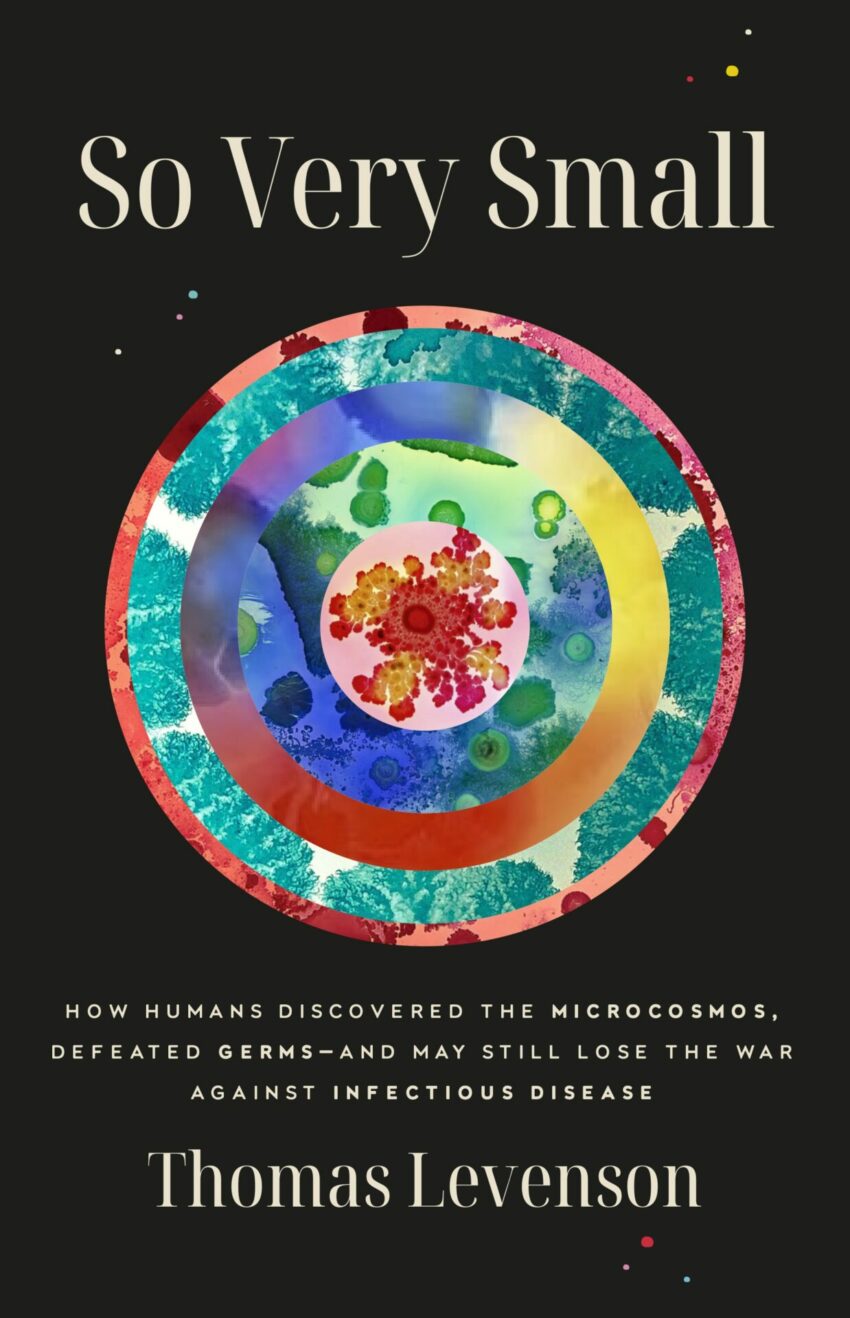
PS: one more thing. As is their wont, my US publisher, Random House, and my UK folks, Head of Zeus, chose radically different cover designs. Got a preference?

(Images below the fold)

show full post on front page

US: So Very Small (Self Aggrandizement Post 1

UK:

So Very Small (Self Aggrandizement Post 2

So Very Small (Self Aggrandizement Post)Post + Comments (122)

Authors In our Midst – Vicki Delany (Canadian Author)

by WaterGirl|  March 20, 202510:00 am| 85 Comments

This post is in: Authors In Our Midst, Foreign Affairs, Politics

We usually run our Authors and Artists posts on the weekend, but this one with Vicki Delany will be the exception.  We have featured Vicki twice here on Balloon Juice, and she is a member of our Balloon Juice community.  (Links to those posts are just below.)

The Enduring Appeal of Sherlock Holmes

Medium Cool – Cozy Mysteries

Vicki is Canadian, so as you can imagine, she has some things on her mind.

show full post on front page

Elbows Up

by Vicki Delany

I am a Canadian, and in the 20 years since I became a full-time author, I’ve travelled to the United States many, many times. I love meeting readers and fellow authors. I love listening to their stories and talking books and brainstorming promotional efforts. Of the three major mystery conferences (Left Coast Crime, Malice Domestic, and Bouchercon) I’ve gone to at least one every year, many years all of them. (COVID years excepted, naturally). I’ve been to smaller festivals and conferences, to libraries, to bookstores. I’ve done a signing in a bowling alley and one in a gym and have been a guest speaker at the Pennsylvania Tea Festival. I’ve toured with wonderful American authors many of whom I now consider good friends, and I’ve spent before and after event time enjoying a vacation.

Is all that over? Possibly. I posted the following to my Facebook author page in February.

With much regret I wrote to the Malice Domestic Board today to tell them I will shortly be cancelling my registration and hotel booking. As a proud Canadian, I can not in good conscience travel to the United States as long as the President continues to insult our Prime Minister and our country and is threatening Canadian sovereignty,  either by destroying  us economically, or invading militarily. I will miss getting together with my many American friends and readers. I hope, but do not expect, that the situation will change and we can meet again.

I believe Canada, and the entire democratic world, is at an existential crossroads. The current regime in the United States is determined, for whatever demented reason, to eliminate Canada as an independent country, by whatever means necessary.  The insults from the President and other members of the regime against our Prime Minster personally (and yes, Governor is an insult and meant as such) as well as the country as a whole  are relentless. The tone and much of the wording is exactly the same as used by Russia prior to its invasion of Ukraine. (Trump: Most Canadians want to be 51ststate. Peter Navarro: Canada has been taken over by Mexican cartels. Elon Musk: Canada is not a real county).

We don’t for a minute believe, even if this comes to pass, we would be a “51st state.”  We wouldn’t be a state, with voting rights and government investment, but a colony, a vassal to be exploited for resources.  We believe this intended exploitation is the entire purpose of this out-of-nowhere threat.

In 2019, the leaders of the United States, Canada, and Mexico negotiated a revised free trade treaty called CUSMA (CanadaUSMexicoAgreement). This treaty is up for renewal in 2026. 2026. Not today. Showing that the word of the President of the United States is meaningless, Trump has overturned the agreement and slapped steep tariffs on Canada and Mexico.

The pretext Trump is using to impose tariffs on Canadian goods (in violation of a treaty he himself signed) is that supposedly Canada is allowing fentanyl to “pour’ across the border. That is an out and out lie.

According to the CNN on Feb 3, 2025 :  Fact check: Canada makes up just 0.2% of US border fentanyl seizures | CNN Politics

Federal statistics show US border authorities seized 21,889 pounds of fentanyl in the 2024 fiscal year. Of that amount, 43 pounds were seized at the Canadian border — about 0.2%

Only a month later, on March 4, 2025,  then Canadian Prime Minister Justin Trudeau quoted data from US customs and border protection:

“..fentanyl seizures from Canada have dropped 97 per cent between December 2024 and January 2025 to a near-zero low of 0.03 pounds seized by U.S. Customs and Border Protection.”

Near zero. Down from a very low figure to begin with.

Therefore, there is literally nothing Canada can do, as the PM pointed out, to fix a problem that does not exist.  (As an aside there are no customs and immigration checks upon leaving either Canada or the US for the other country.  Is it not, therefore, the responsibility of US customs to stop illicit goods coming in? Never mind attempting to solve the fentanyl problem in your country yourselves.)

Why then does Trump keep repeating the lie? Because it isn’t about making trade ‘fair’ or fixing problems that don’t exist, and thus cannot be fixed, but creating circumstances to permit the annexation of Canada’s Arctic, natural resources, and water.

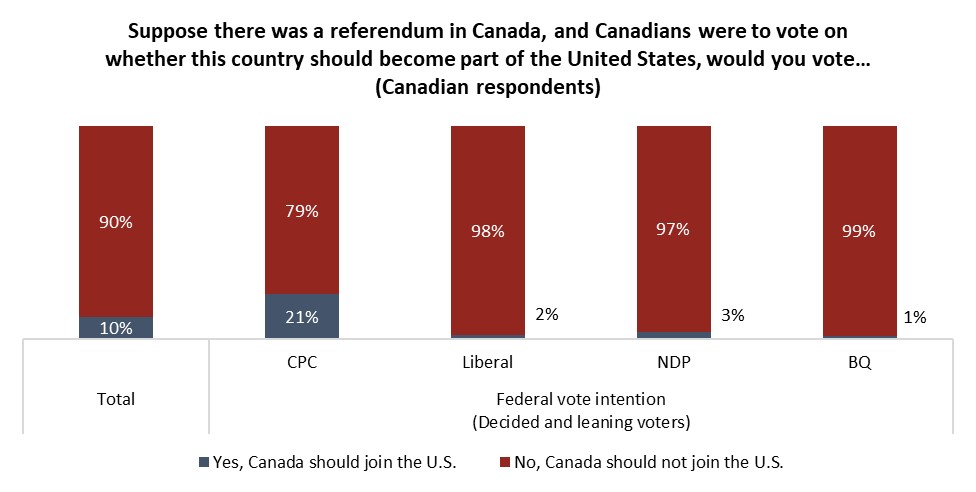
Trump and some of his sycophants keep repeating that Canadians want to be taken over by the US.  (Again, echoes of Putin to Ukraine). It’s a lie.  Here’s a poll reported  March 12, 2025 by the respected Canadian pollster Angus Reid.  The categories are by voters of the federal political parties.

This isn’t a trade dispute; it is an outright attack on our sovereignty and Canadians are coming together in a way they haven’t since WWII.  We are well aware that a trade war hurts everyone, but the Government of Canada believes appeasement will accomplish nothing, so Canada has imposed tariffs on a wide range of US goods.

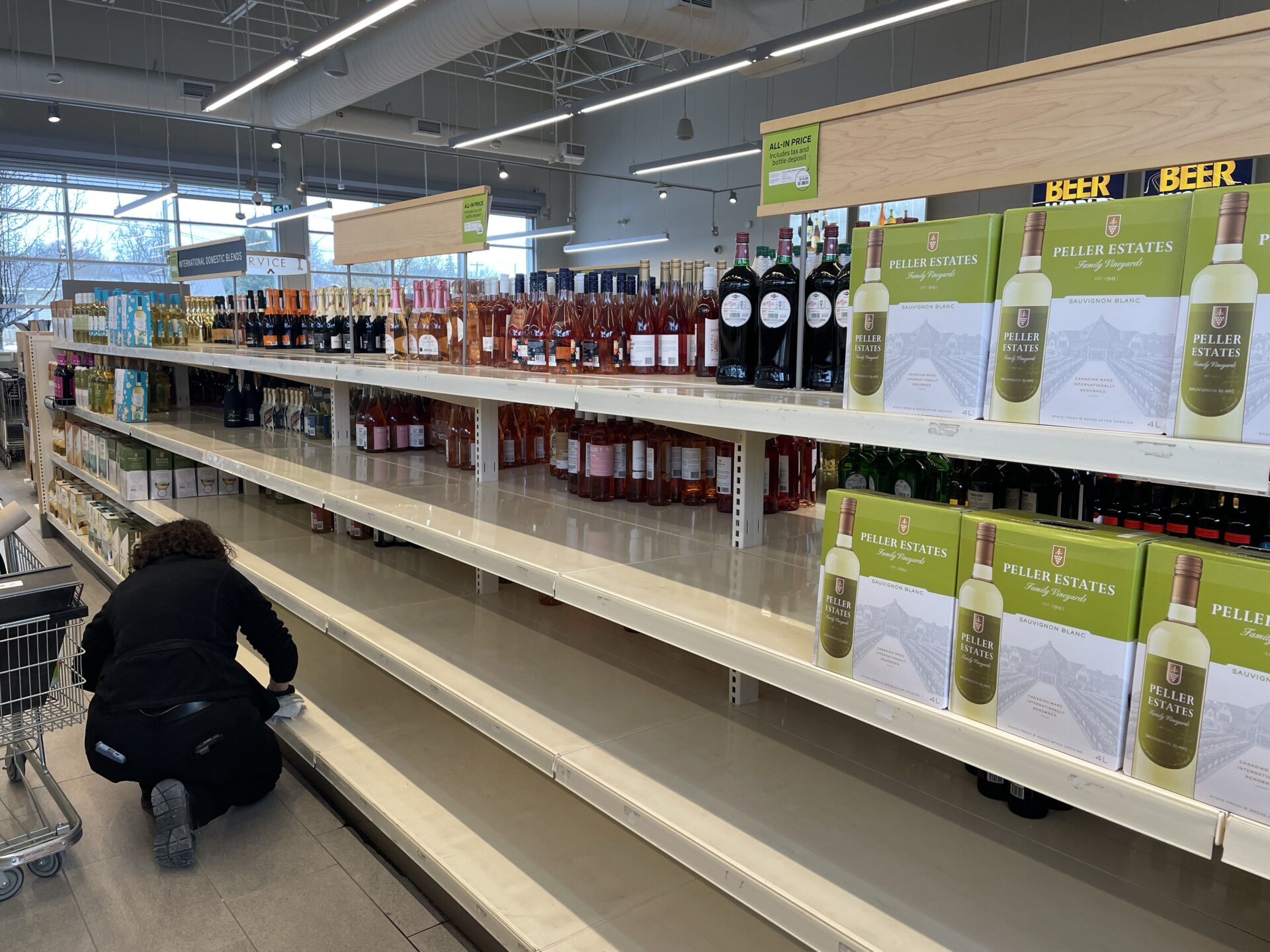
As well as retaliatory tariffs, Canadians are fighting back in other ways. Stores are posting stickers on shelves indicating Canadian goods. Apps are being created to indicate the nationality of companies and the source of their product, and Canadians are taking those apps shopping. The world’s largest purchaser of alcohol is the Ontario liquor stores – all US products have been removed from the shelves and the same thing is happening in other provinces.  The province of Ontario (where I live) announced a 25 percent surcharge on exports of electricity to the US (now on ‘pause’ pending further developments.) Substantial numbers of Canadians are cancelling holidays to the US, or, like me, forgoing optional business trips. The list goes on and continues to grow.

Ontario Liquor Store – March 2025, photo by Vicki Delany

We’re not interested in the game of ‘on-again, off-again, on-again’ Trump is engaging in. As long as the threat exists, Canada will retaliate.

Our new Prime Minister, Mark Carey, has been very clear. “We will never, in any shape or form, be part of the US,” he said on March 14, 2025.

It has been said that Canadians are prepared to sacrifice much in this fight and Americans nothing, so we do have the upper hand. Which of course, considering your President, might not matter.

We will see how things pan out, but I am encouraged by the solid and vocal support we are getting from our many American friends.

There isn’t much I can do, as an average Canadian citizen, to resist these threats, other than make my position public, shop mindfully, and refuse to grace the United States by my presence, definitely not spend any money.

Others have different opinions. Some say it’s important to engage Americans, and point out that despite propaganda from the US leader and members of his party and administration, the overwhelming number of Canadians are firmly against any take-over.  I’d argue in return, we have social media on which to present our case and a substantial number of my American friends approve of my choice to make this clear stand.

I will admit the decision to forgo travel to the US is easier for me than it might be for self-published or small press authors and particularly for writers just starting their career. I have a solid social media following, I have a strong reader base, I’m active in two prominent online cozy mystery groups, I’ve been building my newsletter distribution list for twenty years.

It’s up to each of us to decide what’s best for us and for our country. I’ve made my decision.

Elbows up.

Protect yourself and your teammates.

***

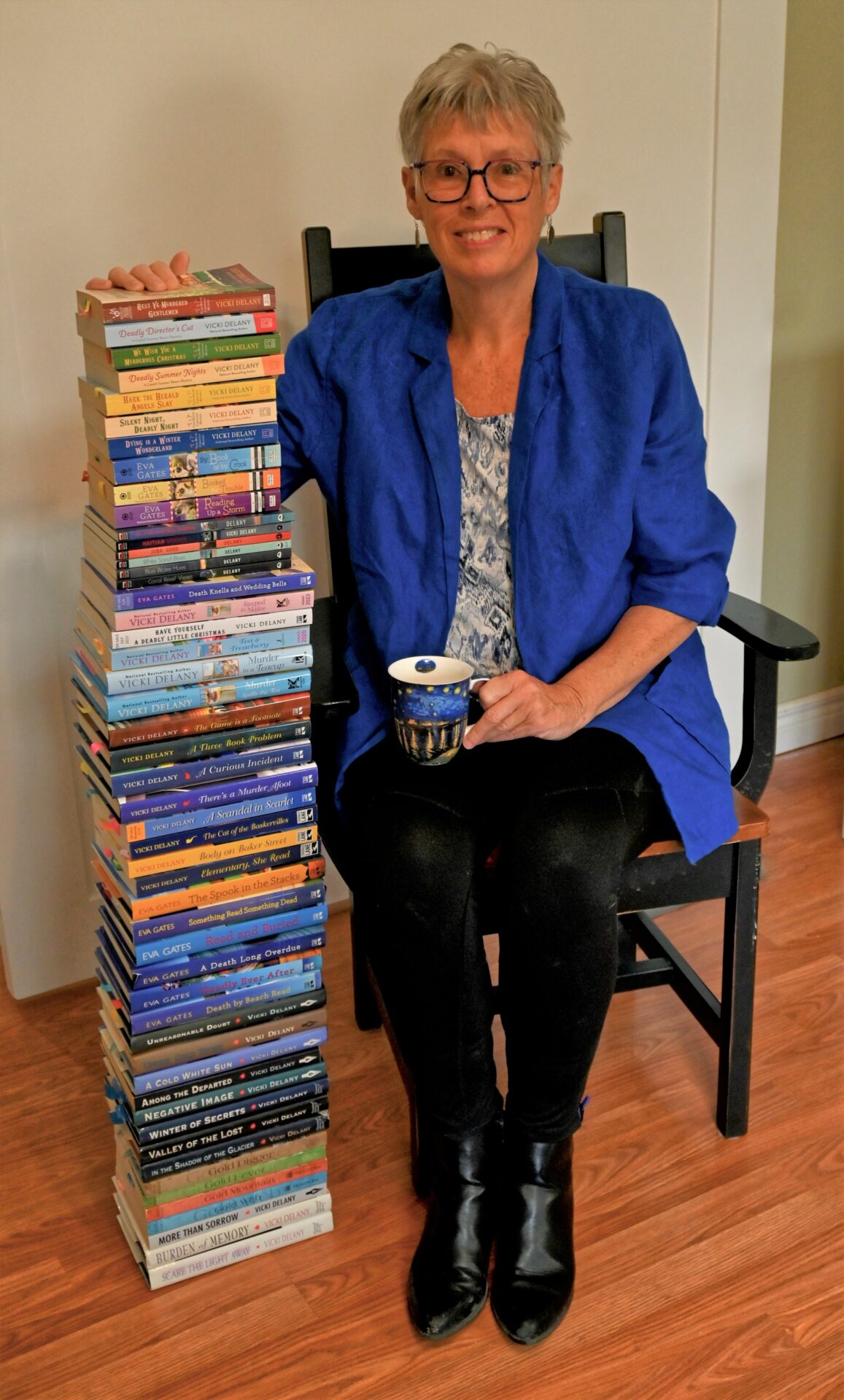
Vicki Delany is the recipient of the 2019 Derrick Murdoch Award for contributions to Canadian crime writing. She is one of Canada’s most prolific and varied crime writers and a national bestseller in the U.S. She has written more than fifty books: clever cozies to Gothic thrillers to gritty police procedurals, to historical fiction and novellas for adult literacy.  She is currently writing the Sherlock Holmes Bookshop series, the Year-Round Christmas mysteries, the Tea by the Sea books, and the Lighthouse Library series (as Eva Gates).

Vicki is a past chair of the Crime Writers of Canada and co-founder and organizer of the Women Killing It Crime Writing Festival.  Her work has been nominated for the Derringer, the Bony Blithe, the Ontario Library Association Golden Oak, and the CWC Awards of Excellence. She lives in Prince Edward County, Ontario.

Let’s have a chat with Vicki in the comments.  I, for one, would love to hear her thoughts on what her American friends here on Balloon Juice can do.  Elbows up!

Authors In our Midst – Vicki Delany (Canadian Author)Post + Comments (85)

  • Page 1
  • Page 2
  • Page 3
  • Interim pages omitted …
  • Page 13
  • Go to Next Page »

Primary Sidebar

On The Road - frosty - 3rd Annual National Park/COVID Challenge - Oregon - Columbia River Gorge National Scenic Area - Engineering
Photo by frosty (4/3/26)
Donate

Election Resources

Voter Registration Info – Find a State
Check Voter Registration by Address
Election Calendar by State

Targeted Fundraising Info & Links

Recent Comments

  • Chacal Charles Calthrop on Open Thread: RETVRN (to the Religious Wars) (Apr 3, 2026 @ 8:54pm)
  • Kayla Rudbek on Open Thread: Banger Memes, Dude (Apr 3, 2026 @ 8:54pm)
  • dnfree on Open Thread: RETVRN (to the Religious Wars) (Apr 3, 2026 @ 8:48pm)
  • sab on Open Thread: RETVRN (to the Religious Wars) (Apr 3, 2026 @ 8:47pm)
  • prostratedragon on Open Thread: RETVRN (to the Religious Wars) (Apr 3, 2026 @ 8:46pm)

Balloon Juice Posts

View by Topic
View by Author
View by Month & Year
View by Past Author

Featuring

Medium Cool
Artists in Our Midst
Authors in Our Midst

🎈Keep Balloon Juice Ad Free

Become a Balloon Juice Patreon
Donate with Venmo, Zelle or PayPal

Calling All Jackals

Site Feedback
Nominate a Rotating Tag
Submit Photos to On the Road
Balloon Juice Anniversary (All Links)
Balloon Juice Anniversary (All Posts)

Fix Nyms with Apostrophes

Outsmarting Apple iOS 26

Balloon Juice Mailing List Signup

Order Calendar A
Order Calendar B

Social Media

Balloon Juice
WaterGirl
TaMara
John Cole
DougJ (aka NYT Pitchbot)
Betty Cracker
Tom Levenson
David Anderson
Major Major Major Major
DougJ NYT Pitchbot
mistermix
Rose Judson (podcast)

Donate

Site Footer

Come for the politics, stay for the snark.

  • Facebook
  • RSS
  • Twitter
  • YouTube
  • Comment Policy
  • Our Authors
  • Blogroll
  • Our Artists
  • Privacy Policy

Privacy Manager

Copyright © 2026 Dev Balloon Juice · All Rights Reserved · Powered by BizBudding Inc