
One of my colleagues, and co-authors, Farrah Madanay is presenting some of our preliminary research this morning at the National Health Policy Conference on benefit terminology in the ACA. We looked at all the different ways insurers described their first tier, in-network benefits on the ACA individual market from 2014-2020. It is a mess:
Consumers are expected to not only compare plans across insurers, but also interpret benefit concepts with terminology varying from plan to plan. For example, “no cost-sharing” is expressed 24 different ways, including $0 copay, 0% coinsurance, “no charge” copay, and “not applicable” coinsurance. A relatively unexplored topic is the complexity consumers face in benefit concept lexicon across marketplace plans. To characterize this complexity, we analyzed cost-sharing descriptions for all standard component plans using public use files from HealthCare.gov.
For instance, the cost-sharing concept of “$1,000 copay after the deductible” is expressed in 13 different ways and the distribution of expression is fairly diverse.
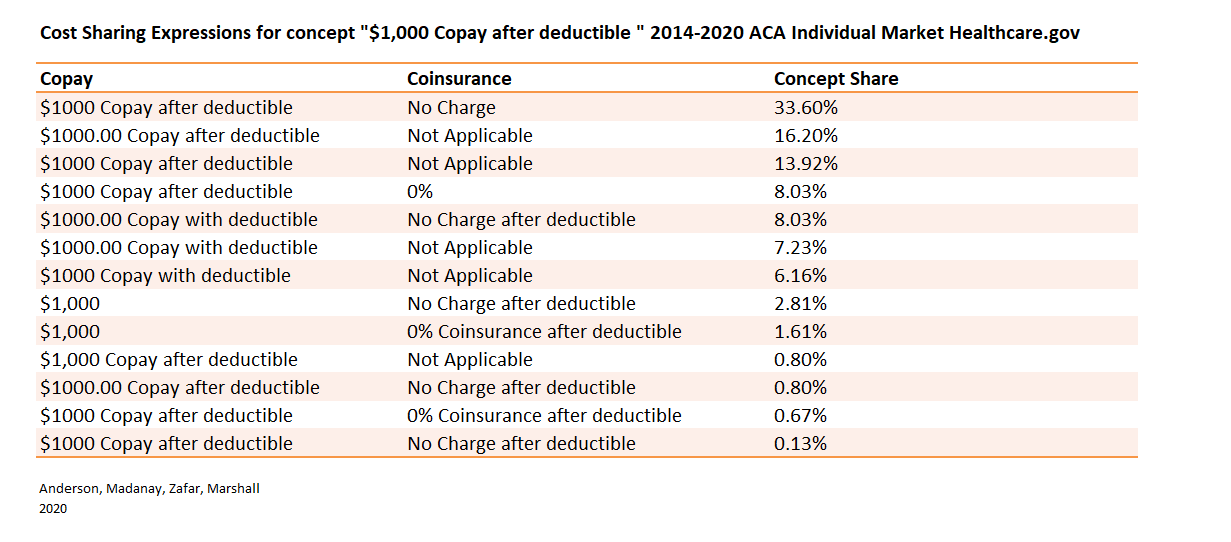
We found that most benefit categories (ie “PCP well visit” or “X-rays” or “Emergency Room” etc) have cost sharing concepts that have lots of variants. We are currently looking at the county-year level exposure to see what is happening there (interesting things but I can’t write about it yet).
Choosing insurance is hard. In an ideal world where we expect people to choose their insurance, we expect them to compare networks, benefit structures, hassle/transition/switching costs, and then also integrate those projections against a probabilistic projection of future healthcare needs that is not uniformly weighed. That is a tough challenge in an ideal choice environment.
We are showing that the ideal choice environment does not exist as people are also expected to translate how Blue Cross describes their benefits against how Aetna or UPMC or Centene describes their benefits. These are tough things to do when most people aren’t spending all day thinking about health insurance; they leave that to geeks like me.
Choice is tough in the best of cases, and we’re not in that universe.
What do you mean — observations on benefit terminologyPost + Comments (22)