
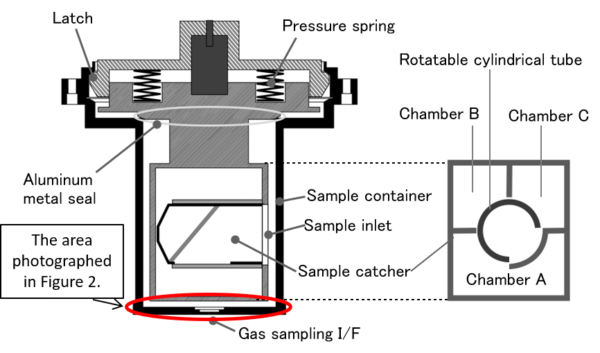
A large number of particles are confirmed to be in “sample chamber A” inside the collected capsule (~11:10 JST on 12/15). This is thought to be the sample from the first touchdown on Ryugu. The photo looks brown, but our team says “black”! The sample return is a great success! pic.twitter.com/34vIx17zOX
— HAYABUSA2@JAXA (@haya2e_jaxa) December 15, 2020
I love this profile!
Confirmation of the asteroid Ryugu sample collection
by the asteroid explorer, Hayabusa2The Japan Aerospace Exploration Agency is pleased to confirm that samples from asteroid Ryugu have been collected within the sample container inside the re-entry capsule of the asteroid explorer, Hayabusa2.
The Hayabusa2 re-entry capsule was recovered in Woomera, Australia on December 6, 2020 and delivered to the JAXA Sagamihara Campus on December 8. Work then began to open the sample container inside the re-entry capsule. On December 14, a sample of grains of black sand thought to be derived from asteroid Ryugu was confirmed to be inside the sample container. These are believed to be particles attached to the entrance of the sample catcher (the container in which the samples have been stored).
Work will continue with opening the sample catcher that sits in the sample container. The curation and initial analysis team will remove the samples and proceed with the analysis.
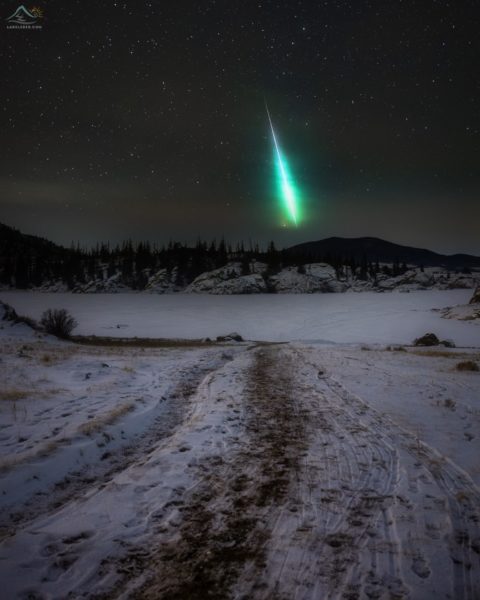
Geminid Meteor at Eleven Mile Reservoir (Colorado)
I watched the Geminid Meteor Shower at Eleven Mile State Park last night. Clouds moved through frequently but I was able to see hundreds of meteors. One was so bright, it lit up the whole ground for a second. Of course it was out of the camera frame. This meteor here was the coolest one I captured. I really like the green glow. Was it worth spending a few hours in up to -11 degrees? I think so.

Similarly, the planet duo will be located in a position that will make it seem as if the two have actually merged. “With bare eyes, it will be nearly impossible to tell if there is one planet or there are two giants next to each other. With binoculars or telescopes, you can see them clearly,” said Dr Abhay Deshpande, a Senior Scientist working for the Government of India and the Honorary Secretary of an amateur astronomy group named Khagol Mandal.
During the conjunction, Saturn and Jupiter will appear just 0.1 degrees apart to an observer on Earth. In fact, they will be so close that both can be easily adjusted in the same telescopic field of view.
The last time the two planets were so close is said to be in 1623—just after famous Italian astronomer Galileo Galilei started observing the sky using a telescope. Such a close approach of Jupiter and Saturn happened earlier in 1623 and 1683, and will happen again in the years 2020, 2080, 2417 and 2477—essentially three pairs of years when the angular separation or distance is nearly 0.1 degree or so.
Open Thread: JAXA Hayabusa2 Asteroid Explorer.Post + Comments (72)