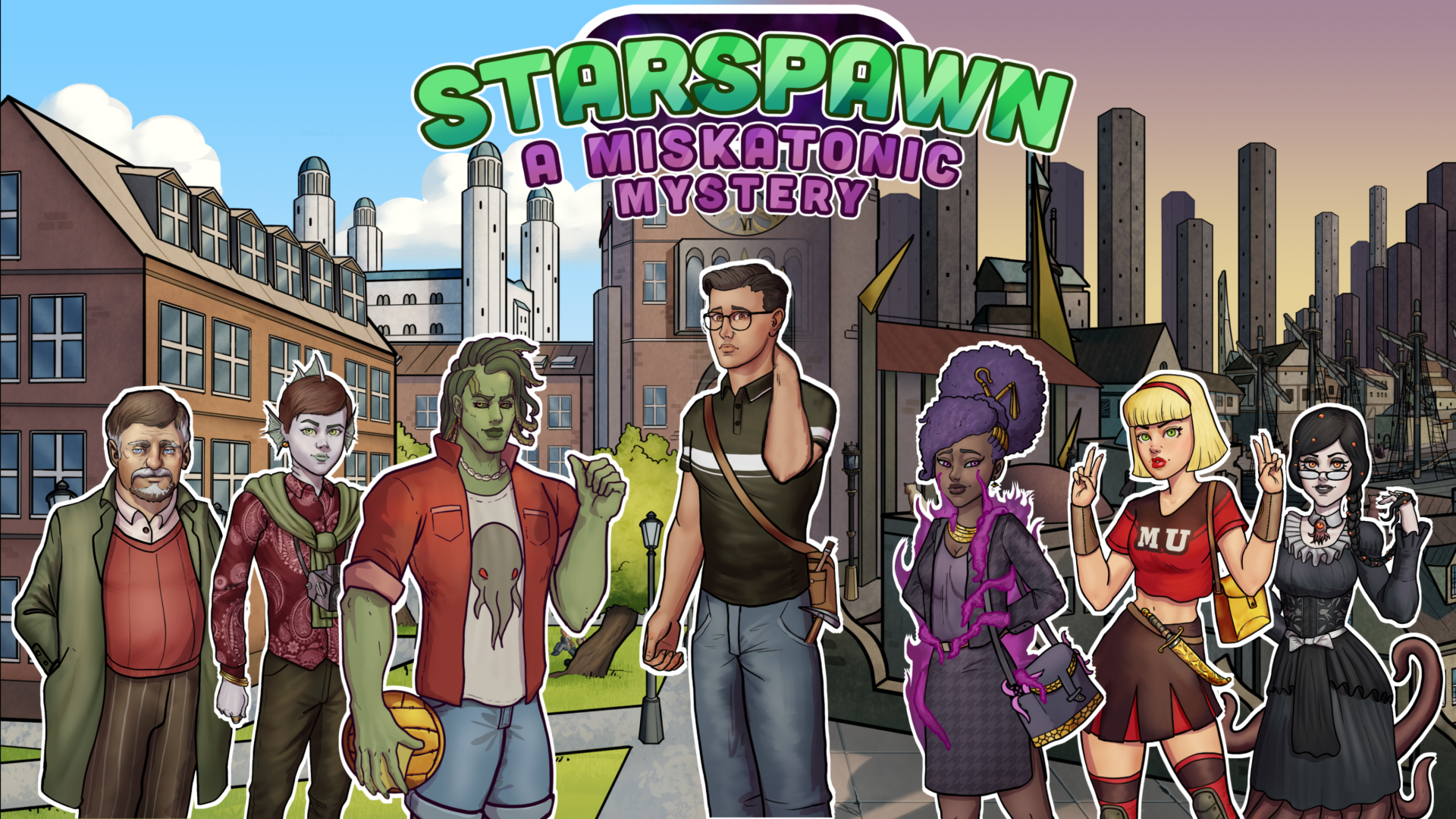
We recently got back from baby Camille’s first trip. We’d been waiting to travel until she got her six-month measles vaccine, on account of *waves hands frantically*, but now that we can, we took her to my sister-in-law’s Tahoe cabin for a week of too much family. I’ll have more to say about that once I get the pictures gathered together. In the meantime! The Kickstarter for me and my friend’s video game is up (with some pretty good goodies), but we reached our fundraising goal super fast, so I didn’t do any shameless self-promotion here. (Prior post about the game here, it’s a Lovecraftian adventure game/dating sim.) As part of our promotional push, we secured an interview with a historian of weird fiction about queerness and gaming in Lovecraftian stories, which is out today. I thought some folks here might appreciate it. You can find it at Deep Cuts in a Lovecraftian Vein.
Lovecraftian horror (and weird fiction more broadly) is as popular as it is because, for many people, it’s challenges some load-bearing defenses about the world we live in. At its root is Lovecraft’s cosmicism, which speaks of the irrelevance of mankind in an uncaring universe full of incomprehensible beings that regard us as we might see ants, if they regard us at all. Or, if you’re already immune to that, there are stories like 2006’s Blindsight, a more scientific tale that challenges our assumptions about the value of consciousness itself. I’ll be honest, that book really did a number on me. And in the best stories, there are also the smaller-scale themes of transformation, hidden knowledge, and the mutability of self–whether you like it or not. And that is where the queerness creeps in…
I’m going to let one of our contributing writers start this one. (Em wrote one of the novelettes we’re including as a Kickstarter reward, and she came up with one of the main characters.)
“[Cosmic horror] stories provide a ripe foundation for exploring non-heteronormative identity because both involve recognizing that consensus reality is more fragile and constructed than it appears. Cosmic horror traditionally focuses on themes of transformation, hidden knowledge, and the inadequacy of established categories, all of which create natural space for examining gender and sexual fluidity without requiring explicit positioning.
The genre frequently features characters discovering their true nature, often something that existed before their conscious awareness or something that has been heavily suppressed. Both resonate strongly with non-binary and trans experiences of self-discovery.
To cap it off, the horror elements can effectively capture both the terror and liberation that can accompany stepping outside normative social structures.”
‘Terror and liberation’ summarizes it pretty well. All of our characters have something like this going on. There’s always something about themselves that they don’t understand or don’t accept. Sometimes part of that is about being queer, but we never sat down and decided to write a queer story, if that makes sense. Starspawn deals with learning to accept yourself and love others, and self-knowledge and transformation and the weight of history. It would be weird if it weren’t at least a little queer.
We’ve found a lot of opportunities to explore these themes.
Queerness and Gaming and Lovecraft, oh my!Post + Comments (23)