• Menu
  • Skip to primary navigation
  • Skip to main content
  • Skip to primary sidebar

Before Header

  • About Us
  • Lexicon
  • Contact Us
  • Our Store
  • ↑
  • ↓

Balloon Juice

Come for the politics, stay for the snark.

If rights aren’t universal, they are privilege, not rights.

The Giant Orange Man Baby is having a bad day.

Hey hey, RFK, how many kids did you kill today?

So many bastards, so little time.

Republicans in disarray!

They are not red states to be hated; they are voter suppression states to be fixed.

DeSantis transforming Florida into 1930s Germany with gators and theme parks.

Stand up, dammit!

I really should read my own blog.

rich, arrogant assholes who equate luck with genius

I see no possible difficulties whatsoever with this fool-proof plan.

Whatever happens next week, the fight doesn’t end.

A tremendous foreign policy asset… to all of our adversaries.

Beware of advice from anyone for whom Democrats are “they” and not “we.”

You can’t attract Republican voters. You can only out organize them.

But frankly mr. cole, I’ll be happier when you get back to telling us to go fuck ourselves.

Red lights blinking on democracy’s dashboard

Impressively dumb. Congratulations.

I’d hate to be the candidate who lost to this guy.

The republican speaker is a slippery little devil.

It may be funny to you motherfucker, but it’s not funny to me.

Hey Washington Post, “Democracy Dies in Darkness” was supposed to be a warning, not a mission statement.

People are weird.

The fundamental promise of conservatism all over the world is a return to an idealized past that never existed.

Mobile Menu

  • 2026 Targeted Political Fundraising
  • Donate with Venmo, Zelle & PayPal
  • Site Feedback
  • War in Ukraine
  • Submit Photos to On the Road
  • Politics
  • On The Road
  • Open Threads
  • Topics
  • Authors
  • About Us
  • Contact Us
  • Lexicon
  • Our Store
  • Politics
  • Open Threads
  • 2026 Activism
  • Garden Chats
  • On The Road
  • Targeted Fundraising!
You are here: Home / Archives for Science & Technology / Tech News and Issues

Tech News and Issues

Mad Cow Disease for Chatbots (Open Thread)

by Rose Judson|  May 30, 20252:46 pm| 120 Comments

This post is in: Science & Technology, Tech News and Issues, Subprime AI

I come to the end of another surprisingly insane week of work and finally look at the news, and what do I see? Multiple stories about the sex life and/or bladder integrity of Elon Musk (also, there is apparently a Glenn Greenwald sex tape floating around the internet, so take care out there).

Let’s think about literally anything else instead.

Mad Cow Disease for Chatbots (Open Thread)
Apologies if you’ve never seen a Terminator movie. Trust me, this is funny.

There’s a story by writer Noor Al-Sibai in Futurism today about a major problem with large language models (LLMs), the jumped-up autocomplete programs we’ve collectively decided to call “AI”. In order to keep progressing, LLMs need to be fed more and more training data. But they’ve chewed through most of the publicly available/easy-to-steal data out there, so AI programmers have to find new sources. First, they tried augmenting human-generated training data with LLM-generated data, or “synthetic” data, instead. They fed the machine what it shits out, in other words.

show full post on front page

This cannibalism approach (or autocoprophagia approach, maybe) can lead to something called “model collapse”. Stephen Vaughan-Nichols explained this concept in The Register, a UK-based tech news site:

In an AI model collapse, AI systems, which are trained on their own outputs, gradually lose accuracy, diversity, and reliability. This occurs because errors compound across successive model generations, leading to distorted data distributions and “irreversible defects” in performance. The final result? A Nature 2024 paper stated, “The model becomes poisoned with its own projection of reality.”

Model collapse is the result of three different factors. The first is error accumulation, in which each model generation inherits and amplifies flaws from previous versions, causing outputs to drift from original data patterns. Next, there is the loss of tail data: In this, rare events are erased from training data, and eventually, entire concepts are blurred. Finally, feedback loops reinforce narrow patterns, creating repetitive text or biased recommendations.

I like how the AI company Aquant puts it: “In simpler terms, when AI is trained on its own outputs, the results can drift further away from reality.”

So an AI chatbot that eats its own shit gets the AI equivalent of a prion disease, and its (metaphorical) brain turns to mush, thus squandering billions of dollars of effort. To avoid this, engineers enabled the models to do something called retrieval-augmented generation (RAG), that is, to pull in data from outside sources rather than just relying on the data they’d been trained with.

The issue, of course, is that there is now so much AI-generated slop text on the web that RAG is just causing the same problem that synthetic data does. The models query an outside source; that outside source is actually chatbot poo, and the models begin to degrade anyway. From Futurism:

So if AI is going to run out of training data — or it has already — and plugging it up to the internet doesn’t work because the internet is now full of AI slop, where do we go from here? Vaughn-Nichols notes that some folks have suggested mixing authentic and synthetic to produce a heady cocktail of good AI training data — but that would require humans to keep creating real content for training data, and the AI industry is actively undermining the incentive structures fo them to continue — while pilfering their work without permission, of course.

A third option, Vaughn-Nichols predicts, appears to already be in motion.

“We’re going to invest more and more in AI, right up to the point that model collapse hits hard and AI answers are so bad even a brain-dead CEO can’t ignore it,” he wrote.

This is, I guess, what passes as good news in these fallen days. Open thread.

Mad Cow Disease for Chatbots (Open Thread)Post + Comments (120)

Weekend Reads: Slop World vs. Deep Reading

by Rose Judson|  April 19, 20252:00 pm| 132 Comments

This post is in: Open Threads, Tech News and Issues, Enshittification

A lazy Saturday is drawing to a close here in the UK. It began with the discovery of a surgically detached mouse head tenderly placed on the living room carpet by the cat. I appreciate him trying to bring me snacks, but I begrudge him the bloodstains on the rug. As my mother used to say to me and my siblings when we were raising hell as kids: “It’s a good thing you’re cute.”

Anyway. I had planned to spend the day dismantling several pallets friends brought me so that I can make planters with them, but it was raining. Instead, I read two articles: “Welcome to Slop World: How the Hostile Internet Is Driving Us Crazy” by Jacob Silverman in the Financial Times (paywall-free Archive.is link here), and “Ultra-Processed Minds: The End of Deep Reading and What It Costs Us” by University College London scholar Carl Hendrick, who studies the science of learning (it’s a Substack, sorry). It seems to me these two go well together.

Silverman’s column goes over ground that Anne Laurie has covered for us here for years: the “enshittification” of the Internet and how that has accelerated in the age of Generative AI slop and confident misinformation. (Take this gem, for instance:)

I am watching the movie Heat and I wanted to check if the actress is a young Angelina Jolie so I went to google and-

[image or embed]

— Nicholas Kole (@nicholaskole.bsky.social) April 19, 2025 at 5:41 AM

Anyway. Silverman bundles together AI slop and enshittification and misinformation under the label “the hostile internet”. He talks about the toll it is taking on us as individuals and as members of online communities:

show full post on front page

The influx of hallucinating chatbots is just the latest sign of the wider internet’s descent into hostility. The internet is now optimised for metrics that have nothing to do with human enjoyment, or convenience, or the profits of anyone except the platform overseers. And it’s only getting worse, as our dependence on these flawed tools grows daily. On a mundane but practical level, I can see this playing out when I go to the website of, say, Audible, and there’s absolutely nowhere there that will allow me to resume playing the audiobook I was just listening to. No play button, no “pick up where you left off”. They prefer you to shop more, so you face a wall of new offerings, but not the thing you’ve been listening to that very day. . . . And right now, there’s little alternative if one refuses to take part in an increasingly degraded digital world. To be online today means navigating an environment whose design feels adversarial, manipulative; it means wading through toxic slop to get to the thing you want. It’s a recipe for cynicism, discontent and dysfunction, wholly in conflict with the democratising impulses that supposedly drove the internet’s development.

Hendrick’s piece seems related to this: how much of today’s Internet content (possibly even this post, being written under the influence of half an Aperol spritz) actively discourages thinking in the reader. He compares it to junk food: “ultra-processed content”:

Not all reading is created equal. Just as not all food nourishes, not all content feeds the mind. In the age of platforms and prompts, of AI authors and infinite feeds, we are reading more but understanding less. What we consume is increasingly pre-digested cognition: engineered for ease, stripped of its vital ambiguity, void of risk. Ultra-processed reading is syntactically smooth, cognitively shallow, emotionally inert. This isn’t just about TikTok or Twitter. It’s about how the medium reshapes the mind, how digital habits dull our appetite for complexity, and how a civilisation that forged itself through the long-form written word might forget what it means to think.

Reading is not natural. It is an acquired skill, hard-won, an evolutionary detour that turned the human brain into a space for rarefied thought; reflection, argument, imagination. And yet, in a digital culture of continuous partial attention, this capacity is undoubtedly slipping from us. What was once a labour of immersion is now a reflex of distraction. The words haven’t vanished, but the reader has changed. This shift from deep reading to shallow skimming, from authored insight to algorithmic noise is no accident. It is the product of platforms, of incentives, of a technological ecology indifferent to meaning. To understand what we are losing, I feel we should begin by noticing how we now read and why it no longer resembles reading at all.

A non-hostile information environment—the sort that Silverman traces the decline of—is crucial for the maintenance of the consensus reality on which democratic societies are built. And as Hendrick explains, it seems as if capacity to read deeply and critically, to care enough to struggle with things that are difficult in order to really understand them, is also in decline because of that information environment. And that too takes a toll on our actual humanity. Again, from Hendrick:

Reflection, nuance, ambiguity, these are not incidental by-products of reading. They are its gifts. And as they fade, so too does our capacity to meet the complexity of the world with anything other than reaction.

This is a complex problem with no easy answer. For me, the solution has been on the individual level: trying to read more challenging material in the hopes that it will inoculate me against becoming a reactionary myself. How we collectively fight these twin pressures, I don’t know. Communities like this one are probably part of it, though. Thank you all for continuing to be here.

That’s all I got. Enjoy your holiday weekend, if you keep it; be safe at the protests, if you’re going to one. If nothing else, enjoy this photo of my stray cat pal, Crusty Oliver:

Weekend Reads: Slop World vs. Deep Reading


Weekend Reads: Slop World vs. Deep ReadingPost + Comments (132)

Friday Evening Cheap Shots Open Thread: Rapid! Unscheduled! Disassembly!

by Anne Laurie|  March 7, 20257:23 pm| 111 Comments

This post is in: Republicans in Disarray!, Space, Tech News and Issues, Elon Musk

Because sometimes we need an easy laugh. *Everything’s* a metaphor, now…

Breakup of SpaceX’s Starship Rocket Disrupts Florida Airports
Video showed the upper stage of the most powerful rocket ever built spinning out of control in space, a repeat of an unsuccessful test flight in January that led to debris falling over the Caribbean.
By Ken Chang
nyti.ms/41KW7oK

[image or embed]

— Eric Lipton NYT (@ericlipton.nytimes.com) March 6, 2025 at 7:46 PM

SpaceX still calling it a "rapid unscheduled disassembly." Also known as an explosion that sent debris falling over thousands of miles.

[image or embed]

— Eric Lipton NYT (@ericlipton.nytimes.com) March 6, 2025 at 8:05 PM

FAA grounds SpaceX Starship yet again. It will not be able to fly again until SpaceX completes an investigation into this accident. Although the investigation from January's flight explosion did not last much longer than a month.

[image or embed]

— Eric Lipton NYT (@ericlipton.nytimes.com) March 6, 2025 at 8:24 PM

Didn’t Trump say he’s asked Elon Musk to take the Space X Starship to the International Space Station to pick up the two astronauts who were stranded up there?

— It’s Too Early For This (@not2early.bsky.social) March 6, 2025 at 8:28 PM

[image or embed]

— Plantsmantx.bsky.social (@plantsmantx.bsky.social) March 6, 2025 at 10:18 PM

Friday Evening Cheap Shots Open Thread: <em>Rapid! Unscheduled! Disassembly!</em>Post + Comments (111)

And Now A LONG Bluesky Post

by Major Major Major Major|  November 12, 20244:57 pm| 90 Comments

This post is in: Open Threads, Science & Technology, Tech News & Issues, Tech News and Issues, Technology

Glad to see more folks are finally hopping on to the only good large* social network! It’s free, open-source, and federated, but you probably don’t care, so it doesn’t make you care; you’ll never notice unless you go looking for it. It’s ad-free, it’s highly customizable, it’s got an incredible block feature, it doesn’t shove fascism into your eyeballs 24/7 whether you like it or not. And now that everyone sees twitter for what it is–a nazi site for nazis–it’s got a lot of the accounts you know and love, and not just artists, trans shitposters, nerds, and the various intersections thereof.

So I thought I’d share some advice on getting started, plus a few philosophical notes. (Signup link)

After an obligatory cat pic of course. Here’s Momo looking enormous thanks to the power of perspective!

Getting started

1. Deprogram yourself

If you’re coming from twitter, you’re fucked in the head, but it’s not your fault. An aggressive algorithmic feed, tweaked by a white supremacist, that suppresses links and optimizes for ragebait, has primed you for a fight-or-flight response when you open the app. The promotion of nazis to the top of every thread has you looking for nazis around every corner. Social media doesn’t have to be like that–but it might take you a minute to undo ten+ years of billionaires trying to convince you otherwise.

It’s time to take a deep breath, roll up your sleeves, and get to work defining your experience for yourself.

2. Check out lists and starter packs

Bluesky does offer two in-house algorithmic feeds–“Discover” and “Popular with Friends”–but all they do is identify and track what topics interest you and your network, and serve you that content. (Pro-tip on Discover: if you click the … button next to a post you see there, you get “show more/less of this” options you can use to help train it.) But the main feed is just your reverse-chronological following feed. So it’s probably a good idea to follow a few people. To make this easy, bluesky has “starter packs”–lists of accounts that anybody can make, that you can follow with just one click. You can search starter packs here–sorting by “uses” will show you the most popular ones, such as a list of politics posters by lolgop, journalists, and legal experts. And of course, a starter pack of balloon-juice peeps (and other good accounts) by mousebumples! You can also search for starter packs by keyword for any special interests you might have.

I also recommend Joshua J. Friedman, who some call the mayor of bluesky.

Some people also make lists instead of starter packs, but there’s no search engine for them. For example, here’s a list of BJ peeps. The users on the list are under the “about” tab; you’ll notice there’s also a “posts” tab and a big “pin to home” button, which brings us to our next very important feature…

3. Follow lots of feeds and change one very important setting

Feeds! Feeds are super cool. Under the hood, a feed is an application that takes API requests and returns posts–which means that a feed can be anything the feed designer wants it to be. Most of them just pull from user lists or match certain words, #hashtags, and/or emojis, but there are more sophisticated ones, too. For example, this feed uses AI to locate cat pictures for you. You can find more feeds with this search engine. Popular ones include science, booksky, blacksky, astronomy, and birds. I also enjoy timeline cleanse and dream logs. Also a special shout-out to the gardening feed, which shares posts by opted-in users that include the seedling emoji 🌱. Check out this thread to see how to get added.

Feeds, just like user lists, have a big “pin to home” button on them. This adds the feed to the right column of the app (on desktop), or as tabs on top of the app (on mobile).

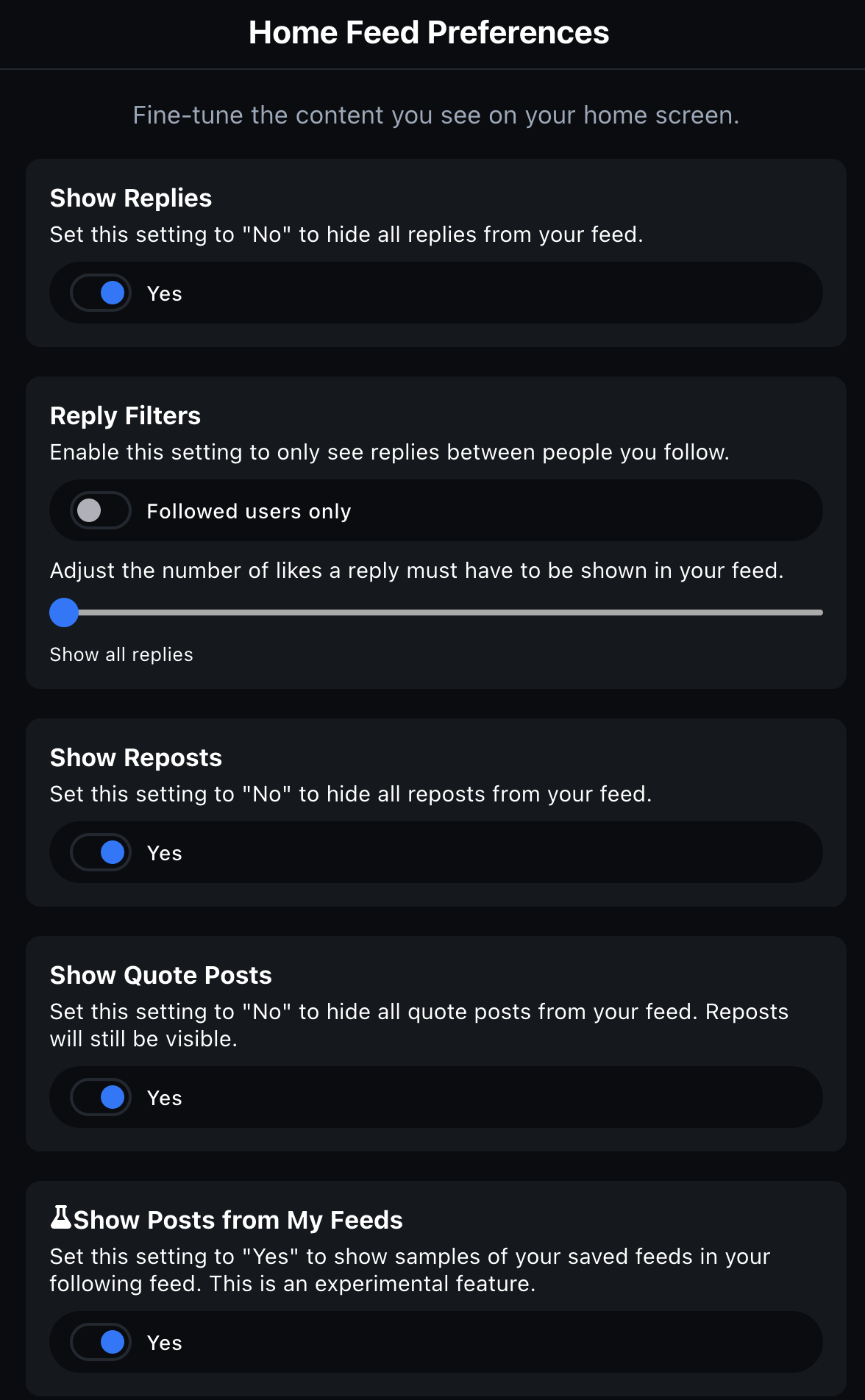
There is also a very neat setting that injects selected posts from feeds right into your following feed. Settings > following feed preferences > “show posts from my feeds”. Highly recommended!

4. Engage!

Bluesky won’t build your following for you. You’ll need to post and reply to people to make it happen. (Smaller accounts are a lot more likely to read your replies; big ones are more likely to have “priority notifications” turned on.) Humor is almost always appreciated, too, though do remember that the failure mode of “clever” is “asshole”.

Also, you can probably get your posts on a lot of feeds just by including the right hashtag or emoji, so there’s a cheap way to get eyeballs on them. Following What’s Mid can also get your stuff out there; it reposts popular-but-not-that-popular posts of yours.

MazeDancer also notes:

And may I plead, again, that you spruce up before you do that. Post 3 or 4 things. Put up a banner. Otherwise, people won’t know who you are – or if you are even a person – or if they would like to follow back.

5. Stop worrying and learn to love the nuclear block

Bluesky has a “block early, block often” ethos. When you block somebody, all your interactions are obliterated. If they have quote-posted you, nobody can see what they are quote-posting (and vice-versa). Threads involving the two of you will be chopped up into little pieces, making them nearly impossible to follow, for anybody. This is a slightly controversial feature but I like it. If somebody quote-dunks you but you don’t want to block them, you can also “detach” it to mimic the blocked-quote behavior.

6. A word about labelers

Bluesky supports third-party labeling services, which attach labels to accounts and posts. This can be used for moderation, or for fun, or just generally to improve your experience. I enjoy xblock, which lets you put twitter screenshots behind a warning; and yardcrow, which gives accounts compliments. There are many more but I don’t think there’s a centralized repository yet. Once you’ve added one, you can adjust how it works in…

7. Tweak your moderation settings

Settings > moderation. Here you can enable/disable/tweak adult content labels (might have to do on desktop if you have an iphone), and adjust how your labeling services work. You can also mute words and hashtags, temporarily or permanently. Also going to give a shout-out to my “tankies and shit” mute/block list, which is full of authoritarian communists, Hamas supporters, and other assorted miscreants. The button says ‘subscribe’, but that means ‘so you can mute or block all of these people at once’.


And now for something completely different: what’s under the hood?

show full post on front page

*(I say ‘large’ because bluesky’s protocol is about broadcasting your actions widely so they can be seen by anybody, whereas mastodon’s is about instance-to-instance agreements for 1:1 communication; a ‘big world’ vs. ‘small world’ approach that they are optimized separately for. I wrote earlier about the key philosophical differences here, as well as how the architecture reflects & supports this.)

Philosophy: The company is a future adversary

That’s part of their mission statement and baked in to the architecture. At a protocol level, most of this has already been realized, though nobody’s built easy buttons for it yet. You own your posts and your social graph; moving everything to a different host is a simple (to me 😛) cryptographic operation that will become friendlier. Already thousands of daily users are hosting their own data. Since the architecture is broadcast-based, the API is by definition free and open, so anybody can build an app without worrying about needing to pay access fees in the future. (People really seem to like deck.blue, a tweetdeck-inspired site/app, though there are several others.) Each primary layer of the open-source protocol has open-source reference implementations, so in the event that Bluesky LLC goes to shit, there will be alternative ways to connect without losing your content, follows, or followers. Team & community members are currently benchmarking independent hosting costs for these and simplifying deployment.

Bluesky is only a couple years old, and does not have a lot of money relative to most services, so the federation isn’t exactly turnkey, but it’s getting there. (The technology was meant to be developed with twitter’s money as a free and open alternative that would eventually be used under the hood, but they got cut off for obvious reasons, and they’ve ended up having to focus on things like “running a social network” at the same time.)

See my earlier links for more details on this than you probably want.

Hope this was helpful!

And Now A LONG Bluesky PostPost + Comments (90)

Bluesky is now open! Sign up today! (A guide to getting started)

by Major Major Major Major|  February 6, 20243:16 pm| 63 Comments

This post is in: Science & Technology, Tech News & Issues, Tech News and Issues, Technology

Bluesky is now open! Sign up today!I’ve been writing posts keeping track of Bluesky development for you all. If you haven’t been following along, Bluesky is a social network, roughly in the style of Twitter. It was hip and new last year. Maybe it will be hip and new again now! Why? Because you can finally sign up without an invite. While it lacks some of the features that more mature services have, like video uploads, it is also not thoroughly saturated with nazis and crypto scam bots, and does not promote the posts by the biggest dumbasses in the world everywhere you go. I think that’s an acceptable trade-off.

More importantly, it has what I think is a true killer feature–custom feeds. Anybody can make one, and you can subscribe to them and have them live natively in the app, and have their posts inserted into your chronological feed. At their most basic they’re just posts from a list of users, but more advanced ones surface content via hashtag or emoji, or an AI recognizing pictures of cats or flowers, etc. There are even several good algorithmic recommendation feeds to choose from, in addition to the default one run by Bluesky itself.

It’s also allegedly going to open to federation this month; click the link at the top of this post for details on how that will work.

There’s a lot more great stuff in the pipeline. Composability will be the name of the game–choose your algorithms, choose your moderation services, choose your host, choose whatever you want. Here’s what WaPo has to say:

That system is a work in progress. So far, Bluesky is the only social network using its protocol. But it already has some features that set it apart. […] For instance, users can subscribe to feeds where algorithms prioritize the most popular posts overall or the posts most popular among the people they follow. There are also options for feeds geared to their specific areas of interest, such as science or art. And users can toggle personal moderation settings that either “hide,” “warn” or “show” categories of content such as nudity, violence, spam and hate-group iconography.

Along with today’s public launch of Bluesky, the company said it will roll out in the coming weeks a step toward its broader vision, inviting some outside developers to host servers that plug in to the main Bluesky network. It also announced a new feature that will let users and organizations begin todevelop their own content moderation services, which other users can then subscribe to. For instance, a fact-checking organization could apply “false” or “misleading” labels to certain posts, which would then be seen by users who opt in to seeing them.

With that out of the way…

A guide to getting started at Bluesky

  1. Sign up at bsky.app!
  2. Give yourself a profile picture and bio. Anything will do, really; it helps set you apart from other users and makes you more approachable.
  3. Find some custom feeds. It’s in the left column on desktop, or the hashtag icon on the bottom on mobile. I recommend:
    • For You, a third-party recommendation algorithm
    • Discover, the official recommendation algorithm
    • Popular with Friends, an official feed of… things that are popular with your friends.
    • Gardening
    • Food
    • Science
    • Cats and Cat Pics
    • A few dozen folks are reading A Wizard of Earthsea for book club this month, you can see some posts about it here, and add your own thoughts by posting about Earthsea, #bskybc, or Gontishmen.
    • And, of course, Newskies, where you can see the first post by every new user in real time.
  4. Under Moderation -> Content Filtering, you can set your preferences for showing/warning/hiding NSFW stuff, hate group iconography, gore, etc.
    1. Note that they’re still working out the, ah, kinks, and you might see some NSFW stuff slip through the filters.
    2. If you signed up on iOS, all mature content is removed from your feed by default; this cannot be changed from your iPhone. Log in at bsky.app and change your preferences there.
  5. Speaking of changing your preferences: I recommend this at Settings -> Basics -> Home Feed Preferences. It will show all posts by people you follow, including when they’re replying to somebody. The one at the bottom is important too–it inserts select posts from your feeds into your chronological following timeline. I also recommend Threaded Mode at Settings -> Basics -> Thread Preferences.Bluesky is now open! Sign up today! 1
  6. Almost everything you do is public on Bluesky, but you can set it so that people have to be logged in to see your posts under Moderation (not in preferences) -> Logged-out visibility, which includes some important caveats in the description.
  7. I maintain a large moderation list of authoritarian communists, Russia simps, etc. I recommend subscribing to it, which will block or mute everybody on it.
  8. Post, post, post! And reply to people, politely of course. It’s the recommended way to get noticed.

You can find me at @thearchduke.bsky.social. Many other jackals are there, please share in the comments. Plus:

  • Anne Laurie
  • Betty Cracker
  • Silverman on Security
  • TaMara

Happy posting!

Bluesky is now open! Sign up today! (A guide to getting started)Post + Comments (63)

Bluesky Update

by Major Major Major Major|  November 17, 20237:18 pm| 108 Comments

This post is in: Open Threads, Science & Technology, Tech News & Issues, Tech News and Issues, Technology

There have been some big developments at Bluesky lately, so I figured I’d drop an update on it, since there’s a good chance you’ll start seeing a lot from there soon. (For those who don’t know, Bluesky is a hip new federated social network in the style of Twitter. I wrote an explainer about it in July here, which is rather long but nothing in it is inaccurate. The project began in-house at Twitter intended as a way to open-source the network, then spun off into their own company.)

I’ve been excited about Bluesky for a while now because it is in many ways a piece of technology I’d been waiting for for years. They’ve learned from the failings of prior attempts at big decentralized social networks, such as Mastodon, and are focusing on meeting users where they’re at, which makes sense since its origin is literally a Twitter-built Twitter replacement. Why should you care? Well–we all know the harms that can be caused by centralized social networks run by billionaires. Some of those may be endemic to large networks, but others, such as what Musk has done to Twitter, and the very real problems this may cause in the world, are caused by centralized control. If you’re worried about Zuck or Musk or whoever having a stranglehold on communication, decentralization may be for you! People can’t own something that cannot be purchased. And while Bluesky is a company, the free and open-source software they have developed is not; “the company is a future adversary” is their motto. (See my post linked above for some key details on how Bluesky is not Mastodon.)

Bluesky offers exciting features like a free and open API, custom algorithms and feeds, multiple third-party apps and websites, account self-verification, and the overall online experience we’ve come to take for granted from a service that isn’t owned by a fascist. Still no gifs yet though.

So: recent developments!

Just yesterday was the anniversary of the first post, and they recently hit two million users, more than 200,000 of whom are active on any given day, which is pretty good.

More importantly: they’ll soon be releasing a public website for viewing posts, allegedly around the end of November. It will still be an invite-only service (although those are fairly easy to come by these days), but once that releases, it will be easily accessible to people who aren’t dweebs. I say “people who aren’t dweebs” because almost everything you do there has been public the entire time, via API. For example, here are all posts about cats in real-time. But a public website will still be a big deal. It will greatly expand the visibility of the network, presumably letting you embed posts in articles and the like. The lack of this feature has been a barrier to adoption for many people (as well as a comfort to others), so this will change the world’s relationship with Bluesky in, hopefully, a big and good way.

The second bit of important (to me, haha) news is that they’ve basically finalized the federation architecture, and plan to open the network up to third parties early next year, once they’ve released their moderation software. What will this mean for the users of bsky.social? Nothing, if the team has done their jobs correctly. For everyone else, it offers some exciting possibilities. You’d be able to run your own service, or hop onto a service run by somebody else, which integrates with bsky.social and offers an experience that is, if you want it to be, indistinguishable from being on bsky.social. Or, it could offer a totally different experience. It’s customizable on so many different layers that with any luck there will be something for everyone. They accomplish this with some interesting architectural decisions. Let’s dive into that below the fold.

show full post on front page

There are three primary services that make up the ATProto ecosystem.

The first is simple enough–your Personal Data Server, or PDS. This is the database where all your actions live–posts, follows, likes, blocks, etc.* Everybody has one. They are meant to be as lightweight as possible.

The second is the Relay, aka BGS, aka Aggregator. This is a large and complex machine that receives notifications from PDS’s and preprocesses them for distribution. So if I make a post, my client sends it to my PDS, which signs it and stores it. Then, my PDS notifies the Relay about this post once (there is only one Relay right now, and will probably only be one for a while). The Relay updates its internals accordingly. If I’ve included an image, the Relay stores it in its Content Delivery Network for efficient distribution. Etc.

The third service is the App View. This is what provides the user experience. When I load the Bluesky app or website, it tells the App View, okay, get me what I need. The App View reads from the Relay stream and manages its own cache of user timelines; it deals with all the performance concerns and is the most complex machine in the ecosystem. (In some circumstances, a handful of requests may make it all the way back to my PDS.) Then it applies various app-level rules, for example, removing all posts by people who have blocked me. Finally it sends them to my phone or browser, which displays them to me. (Muted words, filtering of NSFW content, etc. happen on my device.)

This architecture addresses many of the problems with things like Mastodon and Nostr, which rely heavily on node-to-node communication. By making efficient aggregator Relays the centerpiece of the network, they’ve struck a fine compromise between distributability and usability, in my opinion. The downside is that only people with money can run a Relay, though this is in some ways its own form of protection against petty drama.

Another method for minimizing petty drama is that it is/will be very frictionless to change your host. Your PDS’s data is certified by two cryptographic keys–the one that the host service has, and the one that overrides it, which you have. If you don’t like your host, you can just move your data by signing a message to that effect with your recovery key. Presumably there will be an easy-to-use service that provides this functionality by the time they launch federation. Contrast with Mastodon, where moving your data requires the consent of your former host and your new host, and only moves your followers, not your posts. When you migrate a PDS, you migrate everything, more or less instantly.

And what will federation look like? The main Relay will begin processing messages from PDS’s that are not owned by bsky.social. By default, I suspect, you will log into the same website, read from the same Relay, and pass through the same AppView, as everybody else. But this is all completely client-configurable. If bsky.social starts serving ads, you can switch to an AppView or client that blocks them. Don’t want to see content from fascism.net? AppView or client, assuming the Relay even accepts their posts. Don’t want to see pictures of hedgehogs? The protocol currently supports freeform labeling of posts and users, though to my knowledge it’s only used for NSFW, spam, etc. In the future, there will be labeling services you can subscribe to, that might say “oh this picture is of a hedgehog” or “this person is a hedgehog enthusiast”. At the AppView or client layers, the labelers you’ve subscribed to, and your rules about those labels, will be applied.

And the cool thing is, as of this week, it’s all been released to production. Everybody has their own PDS database that lives in one of ten bsky.social-managed hosts. The PDS’s were migrated out of a monolithic database via the recovery keys. Each PDS broadcasts user events to the bsky.social Relay. The bsky.social AppView reads from the Relay and sends things to your phone. Turning on federation might be as simple as flipping a switch. And that’s where the rubber will hit the road (or the shit and the fan), and Bluesky will sink or swim.

The bsky.social PDS hosts are all named after mushrooms. I ended up on shiitake, which is the least-cool one (I was hoping for puffball or inkcap), but what’re you going to do? Word on the street is that this naming scheme is a reference to a nonsensical viral tumblr post where a mushroom, when threatened, says, “you cannot kill me in a way that matters.” That is the hope for this network. The technology is out there; it’s free; it’s running right now; they’re opening it to everyone soon. It won’t matter who owns Bluesky PBLLC or whether Jack sits on the board. No one person, we hope, can ruin this thing in a way that matters. It’s billionaire-proof by design, after all.

Stay tuned!

—

*PDS records are stored in a single Merkle tree, a self-certifying data structure that theoretically makes distributing updates easy.

Bluesky UpdatePost + Comments (108)

Tuesday Evening Open Thread: Checking In On Twitter’s ‘God Emperor’

by Anne Laurie|  June 20, 20238:06 pm| 67 Comments

This post is in: C.R.E.A.M., Open Threads, Tech News and Issues, Assholes, Schadenfreude

“The Twitter buyout may be one of the worst acquisitions in the history of Wall Street, with something like $37 billion in value flushed pretty much as soon as the deal closed.”

— Via @WilliamCohan https://t.co/DkZkvM8dE7

— Bill Grueskin (@BGrueskin) June 19, 2023

Since Puck is distinctly a niche publication, thought I’d share this piece from ‘former restructuring and bankruptcy advisor at Lazard’ William Cohan, “Will Elon Lose Control of Twitter?”.

(Bad news first, probably not, assuming he still wants to keep it… )

Oh dear, what is going on these days with Elon Musk at Twitter? Let’s see: Twitter is being kicked out of its office in Boulder because—wait for it—Elon decided to stop paying the rent. He’s stopped paying the bills for Twitter’s use of Google Cloud and, according to my partner Eriq Gardner, for JAMS, the arbitration administrator that is adjudicating many of Musk’s legal disputes with his ex-employees. He’s also facing a lawsuit from the Wall Street P.R. firm, Joele Frank, which claims it’s owed more than $830,000 in fees for advice it provided during Musk’s campaign to buy Twitter last year.

As a former restructuring and bankruptcy advisor at Lazard, I can recognize the signs of a company in distress. After all, it’s a pretty obvious tell that there’s financial trouble brewing when a company stops paying its bills as they become due. That’s a recipe for financial disaster, or bankruptcy, or both. Last time I checked, if a company has more than 12 creditors—as Twitter does—then any three of them can join together to put a company into an involuntary bankruptcy proceeding. And Elon is in danger here. At some point, the creditors he is mindlessly stiffing on a regular basis are going to get sufficiently pissed to throw Twitter into bankruptcy.

But I don’t get it, dude. Elon is the world’s richest man, with a net worth of some $233 billion, according to Bloomberg, up an astounding $100 billion so far in 2023. Why is he not paying the people he owes money to? Why is he risking an involuntary bankruptcy filing? And then, of course, there is the upcoming interest payment of around $300 million due to the group of seven or so banks that still hold Twitter’s $13 billion of debt used to pay a portion of the $44 billion Twitter purchase price. I know Elon made the interest payments owed in January and in May. But will he make the next one, due in September? I suppose not paying those (metaphorical) nickels and dimes is one thing. But if he doesn’t pay the banks the $300 million he owes them in September, he will be asking for trouble in the form of a financial restructuring, or worse, a bankruptcy filing…

show full post on front page

What’s as clear today as it was on October 27, when the $44 billion changed hands and Elon took control of Twitter, is that the $31 billion of equity that Elon ($24 billion) and his friends ($7 billion) put into the leveraged buyout of Twitter is gone. It’s a zero. In fact, the Twitter buyout may be one of the very worst acquisitions in the history of Wall Street, with something like $37 billion in value flushed—the $31 billion of equity and about half of the value of the $13 billion of debt, or another $6 billion—pretty much as soon as the deal closed.

Unfortunately for Elon, and his fellow equity holders and the banks still holding on to the $13 billion of debt (which should have been syndicated long ago), he has done nothing in the eight months since he’s owned Twitter to create value for his partners; in fact, just the opposite. He’s destroyed value for the equity and made it virtually impossible for the big Wall Street banks that still own the $13 billion of senior debt to sell it to other investors, unless they are willing to take a huge writedown—on the order of 50 percent—to move the debt off their balance sheets. At some point, the Federal Reserve, the banks’ prudential regulator, is going to force them to sell the debt, perfect their losses, or to take a serious impairment charge against the debt and perfect that loss…

So what is Elon’s game here? Perhaps, as I have written before, he is essentially cosplaying as a bankrupt entity—by not paying his bills as they become due—so that he can scare the big Wall Street banks that own Twitter’s $13 billion of debt to sell it to him at a steep discount, perhaps at a price even lower than the 50 cents on the dollar it would probably trade for now, if marketed to investors. Not that Elon necessarily wants to buy the debt, even at a big discount. But this may be the path of least resistance if he wants to prevent the company from falling into the hands of the voracious distressed debt community on Wall Street who are in the “loan-to-own” business.

Once that bank debt starts to trade, the Twitter fireworks will really begin. If Elon buys the debt, then he can keep control of Twitter for whatever perverse reasons he has for still wanting to own this pig. If the debt gets bought by the likes of DoubleLine Capital, or Apollo, or Oaktree Capital, then all bets are off for Elon and he will lose control of Twitter.

Tuesday Evening Open Thread: Checking In On Twitter’s ‘God Emperor’Post + Comments (67)

  • Page 1
  • Page 2
  • Page 3
  • Interim pages omitted …
  • Page 13
  • Go to Next Page »

Primary Sidebar

On The Road - frosty - 3rd Annual National Park/COVID Challenge - Oregon - Columbia River Gorge National Scenic Area - Engineering
Photo by frosty (4/3/26)
Donate

Election Resources

Voter Registration Info – Find a State
Check Voter Registration by Address
Election Calendar by State

Targeted Fundraising Info & Links

Recent Comments

  • SpaceUnit on Late Night Open Thread (Apr 4, 2026 @ 3:29am)
  • KnowledgeOrPower on Open Thread: RETVRN (to the Religious Wars) (Apr 4, 2026 @ 3:19am)
  • Rachel Bakes on How about a (wide open) Open Thread? (Apr 4, 2026 @ 3:13am)
  • Msb on Friday Night Open Thread (Apr 4, 2026 @ 3:13am)
  • dp on Late Night Open Thread (Apr 4, 2026 @ 2:58am)

Balloon Juice Posts

View by Topic
View by Author
View by Month & Year
View by Past Author

Featuring

Medium Cool
Artists in Our Midst
Authors in Our Midst

🎈Keep Balloon Juice Ad Free

Become a Balloon Juice Patreon
Donate with Venmo, Zelle or PayPal

Calling All Jackals

Site Feedback
Nominate a Rotating Tag
Submit Photos to On the Road
Balloon Juice Anniversary (All Links)
Balloon Juice Anniversary (All Posts)

Fix Nyms with Apostrophes

Outsmarting Apple iOS 26

Balloon Juice Mailing List Signup

Order Calendar A
Order Calendar B

Social Media

Balloon Juice
WaterGirl
TaMara
John Cole
DougJ (aka NYT Pitchbot)
Betty Cracker
Tom Levenson
David Anderson
Major Major Major Major
DougJ NYT Pitchbot
mistermix
Rose Judson (podcast)

Donate

Site Footer

Come for the politics, stay for the snark.

  • Facebook
  • RSS
  • Twitter
  • YouTube
  • Comment Policy
  • Our Authors
  • Blogroll
  • Our Artists
  • Privacy Policy

Privacy Manager

Copyright © 2026 Dev Balloon Juice · All Rights Reserved · Powered by BizBudding Inc