Michael Lewis’ long-form profile of Chris Marks is definitely worth a read [WaPo gift link]. Marks’ pioneering work in mine safety led to the first year in modern history (2016) with no fatalities from roof falls in coal mines. The piece does a lot to debunk the horseshit conservative talking points about industry self-regulating. Here’s one example:
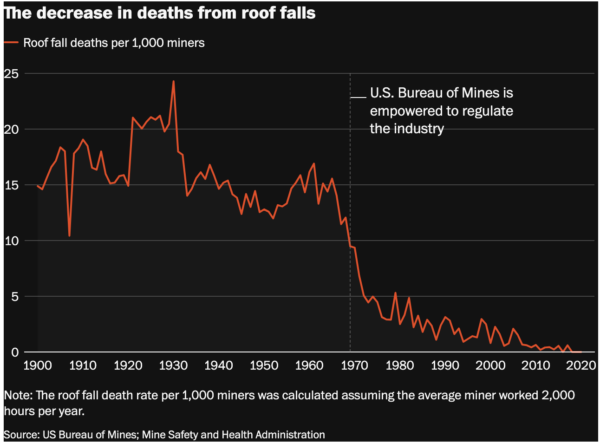
One of the examples in the piece is the introduction of roof bolts to replace timber supports. Even though these could in theory be a safer solution, the invisible hand of the free market worked against safety:
The standard story — the story accepted by the coal mine industry — was that new technology had led inexorably to greater safety. What had happened was far more interesting — and told you how this little American subculture worked, rather than the way economists who had never seen the inside of a coal mine might imagine that it worked. Roof bolts were indeed more efficient and effective than timber supports in preventing chunks of roof from wounding miners. But they were expensive to install. The coal mine companies had, in effect, figured out how few roof bolts they needed to use to maintain the same level of risk their miners had endured before their invention. “Simply stated,” Chris wrote, “roof bolts can only prevent roof falls if enough of them are installed.”
And so, amazingly, for the first 20 years of its use, the main effect of the most important lifesaving technology in the history of coal mining was to increase the efficiency of the mines while preserving existing probabilities of death and injury. Taking advantage, essentially, of people conditioned to a certain level of risk by failing to ameliorate that risk. “No one puts people’s lives at risk per se,” Chris said. “It’s not obvious most of the time that people’s lives are at stake. You’re always playing probabilities. But they knew what they were doing. They could see people dying. Even in a union mine they did it. That is what is so extraordinary. These were not dumb guys. This was a conscious decision.”
It took a catastrophe in Utah in 2007 to change the law so that there was mandatory inspection of mines deeper than 1,000 feet. That led to to the 2016 year without a single death. The irony in this whole roof collapse issue is that roof collapses are very expensive for the mining industry, so they should have a market incentive to increase safety. But, since Supply-Side Jesus is just a myth, it took government regulation to save lives, as it does in so many other industries, such as the meat industry’s recent regulatory failure at Boar’s Head Meats.